.jpg "Hai Phong education stays among the top nationwide")
.jpg "Enhancing climate change education")

Gửi bình luận
Hai Phong identifies investment in people, high-quality education, and international integration as the shortest and most sustainable path to development.
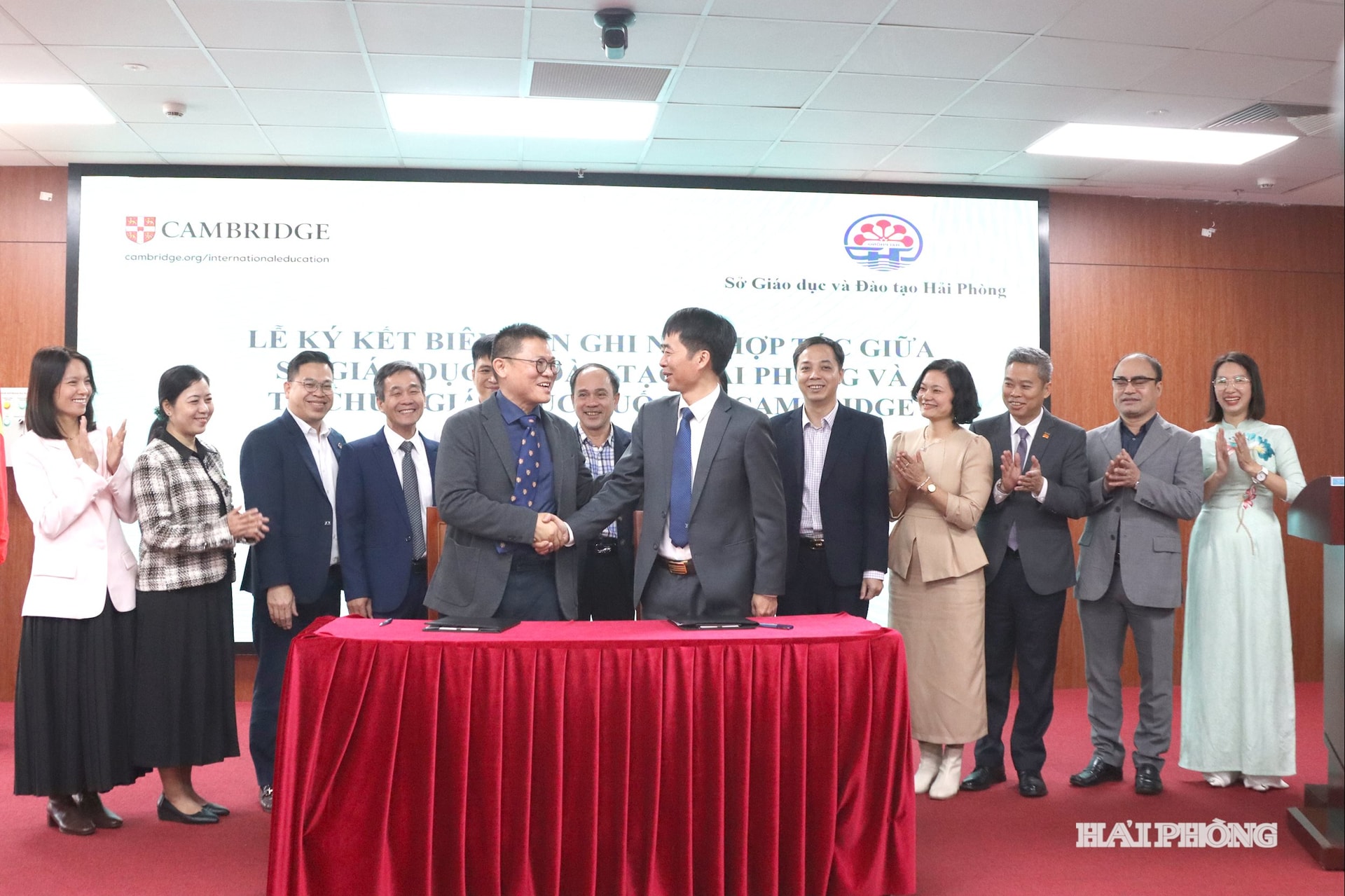
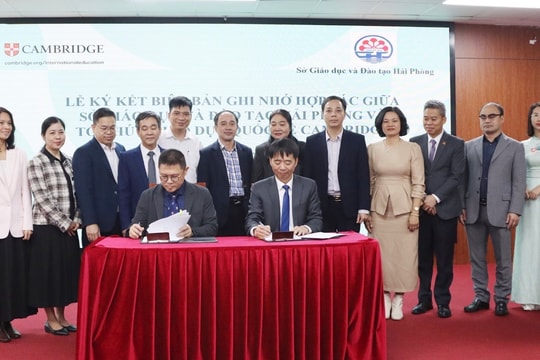
In the era of the knowledge-based economy, competition among localities no longer hinges on natural resources or infrastructure, but on the quality of human capital. Education has therefore become a strategic foundation for shaping the future. The recent signed Memorandum of Understanding between the Hai Phong Department of Education and Training and Cambridge International Education—an organization under the University of Cambridge (United Kingdom), is regarded not merely as an educational partnership, but as a strategic move in developing the city’s future workforce.
A highlight of this cooperation is the official promotion of teaching Mathematics and Science in English. This marks a fundamental shift in educational thinking, from training students to “know” to training students to “do” in a global environment. When Mathematics and Science—two pillars of innovation—are taught in an international language, students not only gain knowledge but also learn how to think, communicate, and apply that knowledge in real-life contexts. Hai Phong thus becomes one of the pioneering localities in Viet Nam preparing students for international competitiveness from an early stage.
Choosing Cambridge International Education as a strategic partner carries special significance. As part of the University of Cambridge with over 160 years of experience, Cambridge programs are implemented in more than 160 countries worldwide. In Mathematics and Science education in particular, Cambridge emphasizes not only subject knowledge but also critical thinking, problem-solving skills, and real-world application. When these subjects are taught in English, Hai Phong students are no longer learning merely for examinations, but for integration and future in multicultural, multinational environments—where professional competence and language proficiency must go hand in hand. This is the core, sustainable, and distinctive value of the partnership.
The agreement with Cambridge represents an important link in Hai Phong’s long-term education development strategy, especially as the city is formulating the “Education and Training Development Scheme of Hai Phong to 2030, with a vision to 2045.” The scheme aims to position Hai Phong as one of the country’s leading education and training centers, playing a key role in developing high-quality human resources for the Red River Delta region, while gradually building a modern, innovative, and internationally integrated education system aligned with regional and global standards. Within this strategy, foreign language development—particularly English—is identified as a critical pillar, in line with the Government’s orientation of making English a second language in schools.
Beyond policy direction, Hai Phong has demonstrated strong commitment through concrete action plans and a clear roadmap. The city’s education sector has developed a pilot plan to integrate the Vietnamese national curriculum with Cambridge certifications such as Primary Checkpoint, IGCSE, and A-Level at 21 public schools, scheduled for implementation from the 2026–2027 academic year. This serves as clear evidence of a practical approach: turning cooperation into action, vision into a roadmap, and commitment into tangible, measurable results.
It can be affirmed that the Memorandum of Understanding between the Hai Phong Department of Education and Training and Cambridge International Education is not merely a cooperation agreement, but a declaration of strategic choice. Hai Phong is investing in people, high-quality education, and international integration as the shortest and most sustainable path to development. This step clearly reflects the city’s spirit of innovation and aspiration to rise strongly in the new era of national development.
Bui Hanh