.jpeg "FPT breaks ground on Hai Phong education complex, set to serve 5,800 students")
.jpg "Hai Phong education stays among the top nationwide")
.jpg "Enhancing climate change education")

Gửi bình luận
Hai Phong is developing its education system in a synchronized and diversified manner, gradually moving toward international standards to improve the quality of human resources.
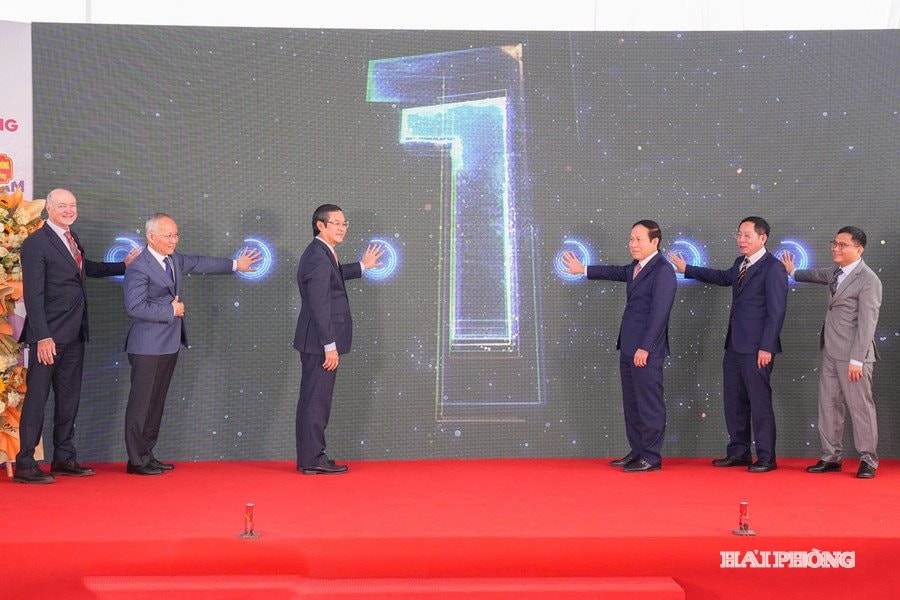
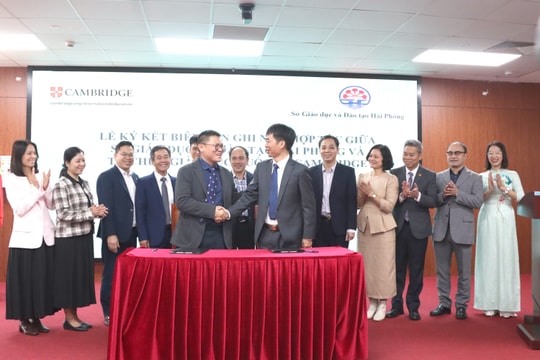
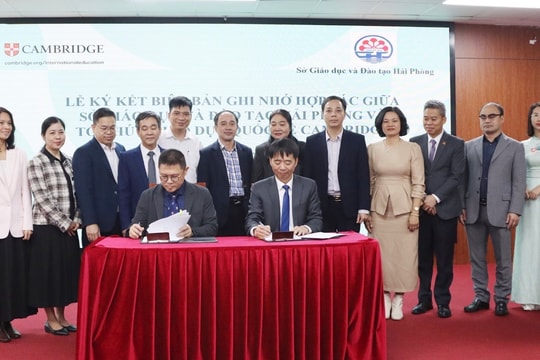
In the first two months of 2026, Hai Phong launched construction on two large-scale education complexes and signed a memorandum of understanding with Cambridge International Education—a unit of University of Cambridge (United Kingdom)—to introduce its programs into the public school system. These steps not only expand the city’s training capacity but also reflect a clearer direction toward improving quality and strengthening connectivity within the city’s education system.
Specifically, the Bac Song Cam Education Complex, invested by EQuest Education Group, is designed to accommodate around 20,000 students, while the education complex developed by FPT Corporation in Hai Phong is planned for nearly 6,000 learners. Both projects follow an integrated education model linking general education with college and university programs, emphasizing practical training and alignment with labor market demands. The development of such integrated training models helps diversify the city’s education system and expands opportunities for students in Hai Phong and neighboring areas to study in advanced learning environments.
The pilot introduction of the Cambridge program in 21 public schools has created a fundamental shift in quality standards. No longer limited to international schools, advanced assessment standards and learning materials are gradually being integrated into the mainstream public education system. This move expands access to modern learning environments and promotes the comprehensive development of students.
In the new context following administrative consolidation, as Hai Phong rises to become the locality with the third-largest economic scale in the country, the demand for human resources is shifting from quantity to quality, skills, and international integration. A large-scale economy developing toward modern industry, logistics, and international services requires a highly skilled workforce with open-minded thinking and the ability to adapt quickly to change. Therefore, raising educational standards and expanding access to advanced training models is not only aimed at improving teaching and learning quality but also at preparing a workforce capable of participating more deeply in global value chains with high technological content in the future.
Within the overall development strategy toward 2030 with a vision to 2045, Hai Phong aims to become a center for education, training, and scientific research in the Northern Coastal region. Recent positive developments indicate that the city’s education system is being adjusted to align more closely with the needs of economic development, especially as Hai Phong continues to rise among the country’s major economic centers.
Under these conditions, diversifying training models, expanding access to advanced educational environments, and gradually approaching international standards will not only improve teaching and learning quality but also help build a workforce with strong professional expertise, skills, and the capacity for global integration. This is a decisive factor in maintaining growth and enhancing the city’s competitiveness.
It can be said that Hai Phong is gradually developing its education system in a synchronized manner, diversifying training models, and expanding opportunities for students to access advanced learning environments. At the same time, the system is steadily moving toward international educational standards to meet the demand for improving the quality of human resources in the new stage of development. These efforts will help form a skilled and globally integrated workforce, creating a solid foundation for the city to enhance its competitiveness and meet the requirements of rapid and sustainable development in the years ahead.
Bui Hanh