
.jpeg "FPT breaks ground on Hai Phong education complex, set to serve 5,800 students")
.jpg "Hai Phong education stays among the top nationwide")

Gửi bình luận
Private investment in education in Hai Phong has gained momentum in recent years, but the results have yet to fully reflect the city's potential, underscoring the need for stronger measures to mobilize non-budget resources more effectively.
Potential yet to be fully tapped
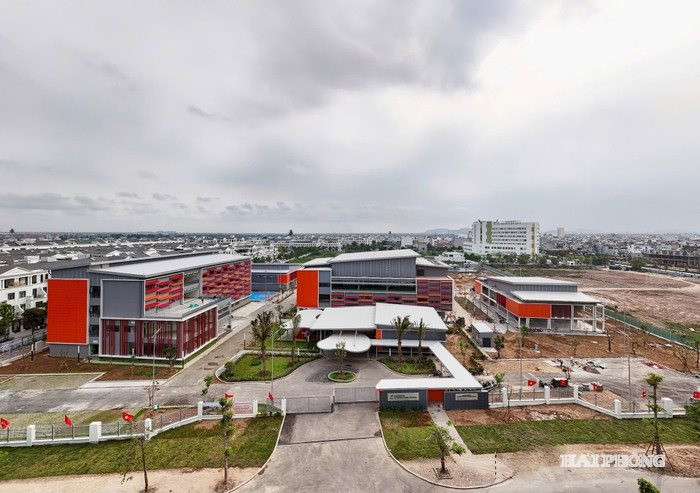
In 2025, the Singapore International School complex in Le Chan ward was inaugurated with total investment of around 360 billion dong. The project provides education from kindergarten to international high school level, meeting growing demand among students in the city.
The project was among 56 private school developments attracted by the city during the 2020-2025 period. Over the same period, Hai Phong mobilized investment for 178 education projects under its socialization program, with total registered capital exceeding 4.45 trillion dong. A total of 43 private kindergartens, two private primary schools, one private secondary school and 12 private high schools were established across the city.
As of June 2026, Hai Phong had 216 private educational institutions out of a total of 1,662 institutions from preschool to university level, accounting for around 13%. The private sector has helped ease pressure on the state budget, reduce the burden on public schools, diversify educational models and services, and better meet rising demand for education.
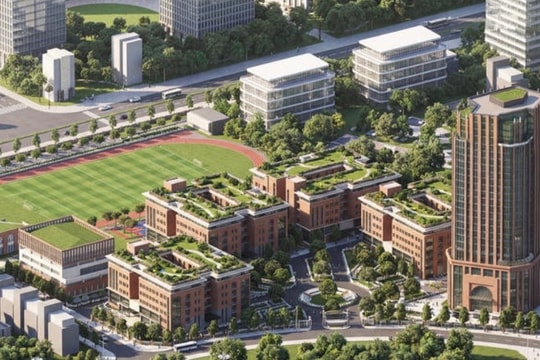
Hai Phong's appeal as a destination for education investment continued to strengthen in 2026. In March, FPT Group broke ground on an education complex in Phu Lien ward with a total investment of 650 billion dong. Around the same time, EQuest Education Group launched construction of the Bac Song Cam Education Complex and introduced its education ecosystem in Hai Phong at the Bac Song Cam New Urban Area.
The rollout of a series of large-scale projects points to growing momentum in the city's efforts to attract investment into education. However, according to the Department of Education and Training, the progress made has yet to match the potential and advantages of Hai Phong, a centrally-run city and a major economic, political, cultural, defense and security center in Vietnam's northern coastal region.
At present, non-budget investment is concentrated mainly in preschool, primary and high-quality high school education in central areas. Meanwhile, suburban, rural, island and industrial areas, where demand for quality educational services is high, have yet to attract significant investment.
Towards becoming a leading education hub
In the spirit of Politburo Resolution No. 71-NQ/TW dated Aug. 22, 2025 on breakthroughs in education and training development, the Standing Committee of the Hai Phong Party Committee issued Action Program No. 02, while the city People's Committee approved the project titled "Development of Hai Phong's Education and Training Sector to 2030, with a Vision to 2045".
Under the project, Hai Phong aims to become one of the country's leading education and training centers and play a key role in developing high-quality human resources for the Red River Delta region. The city also aspires to become an international center for education, research, scientific and technological applications, and the marine economy.
To achieve these goals, the city has set out a number of specific targets. Under the project, Hai Phong aims to attract investment in about 18 private educational institutions during the 2026-2035 period. These include 17 institutions from preschool to high school level with projected investment of around 1.7 trillion dong, and one international school with estimated investment of about 360 billion dong.
The city maintains that public education should remain the backbone of the system, while private education is regarded as an important component of the national education system. It aims to build an open education system and encourage the development of high-quality private institutions. At the same time, public investment is expected to play a leading role in mobilizing social resources for the comprehensive modernization of the education system.
According to Do Duy Hung, deputy director of the Department of Education and Training, the department has worked closely with relevant agencies to advise the city on improving mechanisms and policies, including land-rent exemptions for non-profit education projects under the socialization program.
The measure is seen as key to creating a more favorable legal framework and making the investment environment more attractive, thereby helping draw more non-budget resources into Hai Phong's education sector and supporting its development in the years ahead.
Hai Phong News