

Gửi bình luận
After nearly two years of implementation, the pilot cultivation model of Shine Muscat grapes and Summer Black grapes in An Phu Commune has delivered encouraging initial results, opening up a new production direction in the restructuring of local crop cultivation.
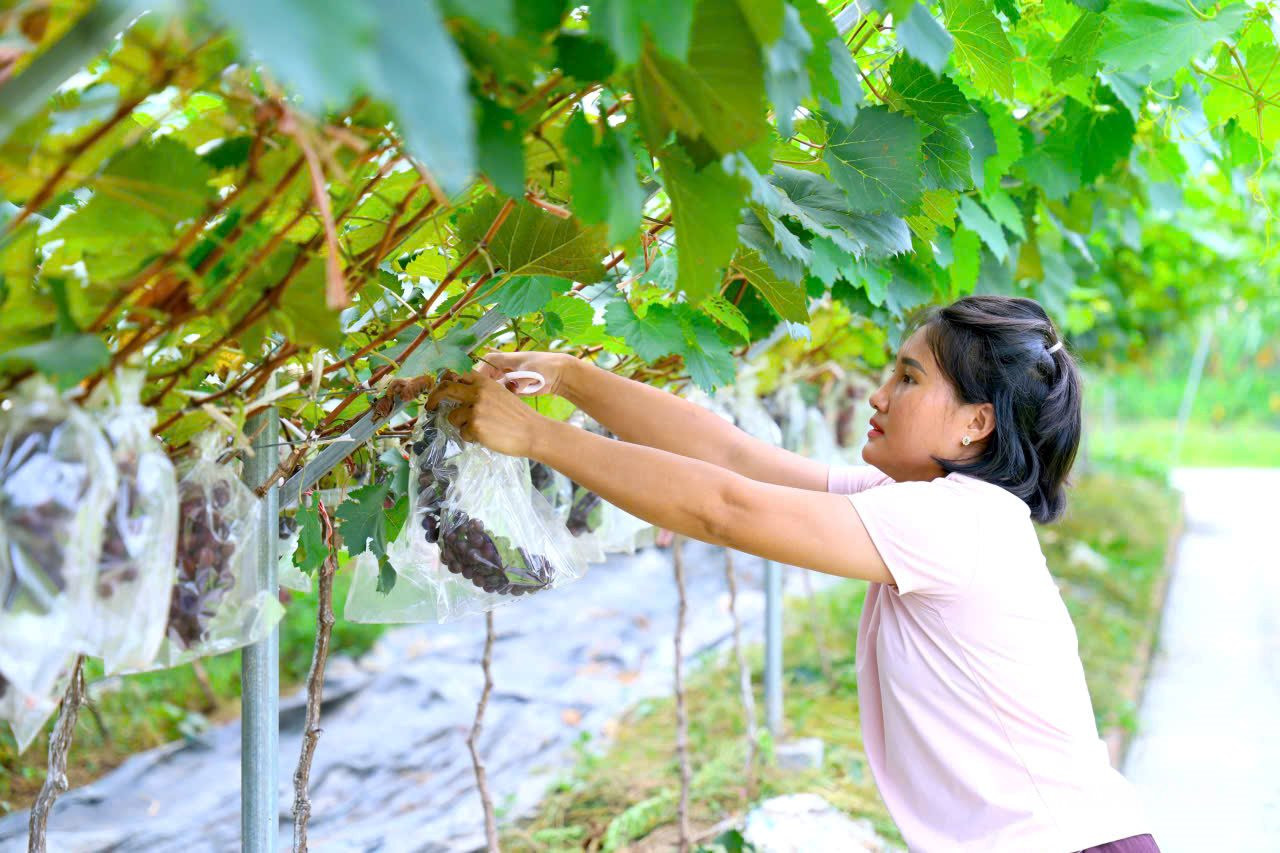
In An Phu Commune, the high-tech cultivation model of Shine Muscat grapes and Summer Black grapes has emerged as a highlight in the search for suitable crops adapted to local conditions. This model is part of the research project “Application of Technical Advances to Develop High-Tech Cultivation Models for Shine Muscat and Summer Black Grapes,” implemented by the Center for Science and Technology Application and Innovation (formerly under the Department of Science and Technology of Hai Duong Province, now the Center for Innovation and Science and Technology Application of Hai Phong City) for the 2024–2026 period.
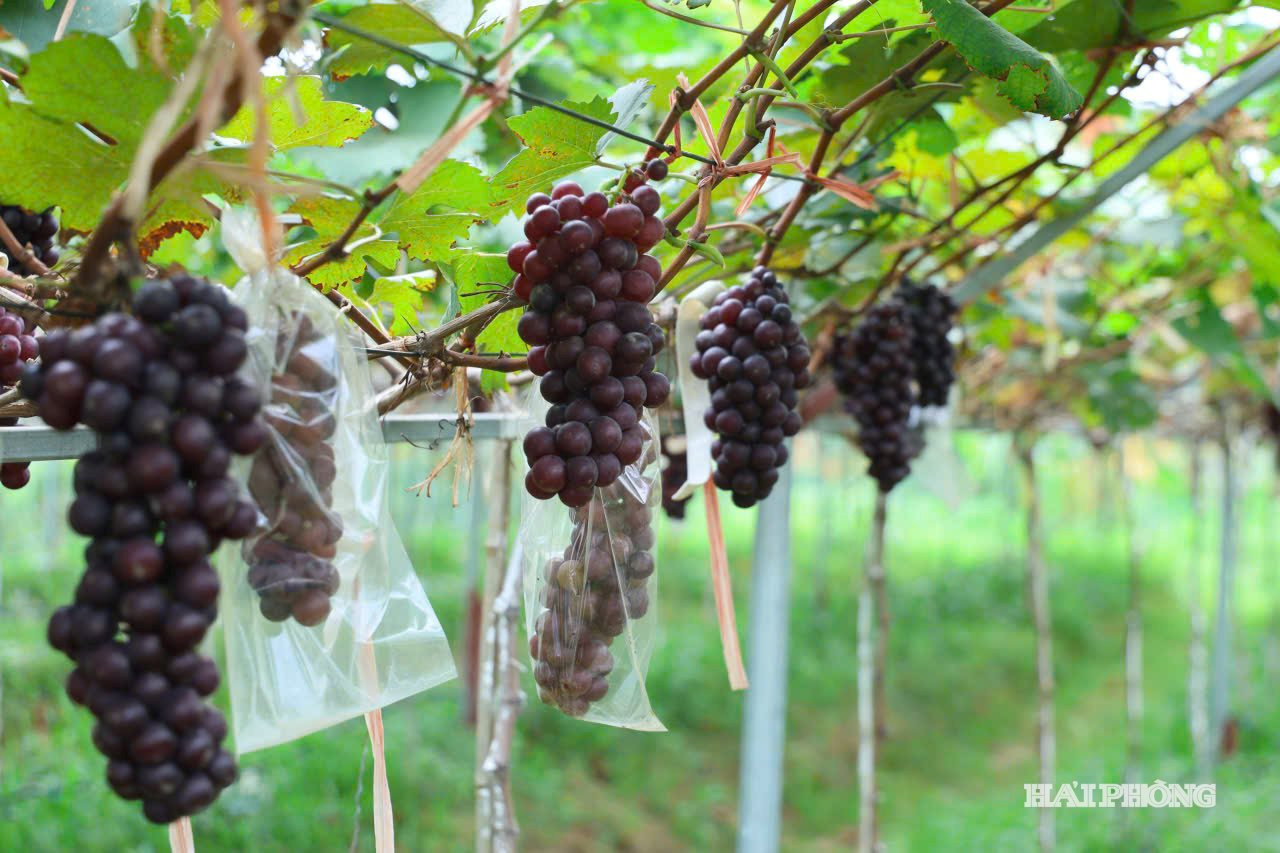
The model is carried out on a total area of 6,000 m², including 3,500 m² for Shine Muscat grapes and 2,500 m² for Summer Black grapes. After 22 months of implementation, the survival rate of plants has exceeded 97%; stem diameters of Summer Black grapes range from 1.5 to 2.1 cm, while Shine Muscat grapes range from 1.7 to 2.3 cm. The grape varieties show strong growth, healthy green foliage, low pest and disease incidence, and good adaptability to local climate and soil conditions.
To date, the vineyards have entered their second harvest season, with estimated yields of about 11.8 tons per hectare for the Summer Black variety and 12.1 tons per hectare for the Shine Muscat variety. Fruit quality is relatively uniform, with attractive appearance and strong market demand, demonstrating the development potential of these two grape varieties in An Phu.
To achieve these results, the model has applied a range of advanced techniques, including modern trellis systems, water-saving irrigation, nutrient management, and environmentally safe pest control. The application of science and technology has contributed to improving productivity and product quality while reducing labor requirements and production costs.
Mr. Nguyen Van Nam, an official from the Department of Economics of An Phu Commune, said: “Practical monitoring shows that Shine Muscat and Summer Black grape varieties are generally suitable for the local climate and soil conditions. The plants grow steadily, have low pest pressure, and initially meet yield expectations.”
Towards sustainable development
Alongside these positive results, the implementation process also raises several issues that need to be addressed if grapes are to be developed into a stable commercial product.
Mr. Dang Van Gioi, the technician directly in charge of his family’s vineyard, said that demand for clean agricultural products and organically oriented production is increasing. At the current scale, the model’s output basically meets local consumption demand and has received positive feedback from consumers.
The model has also benefited from investments in net houses and greenhouses under a scientific research project, helping to improve production processes and gradually build branding, quality certification, and future zoning for cultivation areas.
However, according to Mr. Gioi, cultivation conditions still face many limitations. The soil is not yet fully optimal for grape growing, and water is sourced externally, making quality control difficult. The production area has also not been planned as a concentrated farming zone and lacks clear buffer boundaries with surrounding land, increasing the risk of impacts from pesticide use, insects, and diseases.
In addition, organic-oriented production requires high technical standards, while local growers still lack in-depth technical guidance materials and mainly rely on accumulated experience through practice and learning-by-doing.
Given this situation, local authorities have affirmed that they will continue to support farmers. Mr. Nguyen Van Nam said that An Phu Commune will coordinate with specialized agencies to provide technical guidance, monitor the effectiveness of the model, and scale up suitable practices. At the same time, under Resolution No. 51 of the City People’s Council, the locality will facilitate access to support policies, including technical training, partial funding for initial investment costs, and incentives for the application of science and technology.
Despite remaining challenges in techniques, markets, and production conditions, the model initially shows that grape cultivation can adapt well to the An Phu area, opening up new options for crop restructuring and the development of modern, high-value agriculture.
Thuan Nga