.jpg "Hai Phong builds digital talent triangle")


Gửi bình luận
Hai Phong is gradually establishing a unified data governance model, turning data into a strategic resource to serve digital government, the digital economy and digital society.
From updating data to governing data
In 2026, Hai Phong has begun laying key foundations for data governance by issuing a Data Architecture Framework, a Data Governance and Management Framework, a Common Data Dictionary, and the Hai Phong City Data Strategy for 2026–2030, with a vision to 2045.
Key digital platforms such as the Open Data Portal, the Smart Hai Phong application, and the digital communication platform between the government, residents and businesses continue to be maintained and effectively utilized. As a result, data connection and sharing among agencies are carried out smoothly.
The Open Data Portal serves as a centralized channel for aggregating and providing data from the government, organizations, residents and businesses across the city. To date, the portal has integrated 359 datasets from 15 departments and sectors, covering 25 fields including labor, transportation, environmental protection and construction. Officials, civil servants, residents and enterprises can access, exploit and download data via the website and mobile devices.
The city’s Data Center operates stably and securely, supporting 91 common and sector-specific information systems. Combining infrastructure with cloud computing services has expanded storage, processing and data exploitation capacity, meeting the requirements for developing digital platforms in the new phase.
These results show that open data is no longer just an information channel; it has become a critical component of the digital ecosystem, enabling more transparent, flexible and data-driven government operations.
Turning data into a development resource
In September, the city organized 10 training courses on digital data governance and exploitation for dedicated officials across departments, sectors and localities. This is one of Hai Phong’s concrete steps to move from ‘updating data’ to ‘governing and exploiting data’, shifting the perception that data is not solely the responsibility of IT units but an asset of each agency, unit and the city as a whole.
According to the city’s Data Strategy, by 2030, 100 percent of databases in the lists of common and sector-specific databases prioritized for implementation must be digitized, updated and put into effective use. All state agencies in the city are required to open and provide quality-assured open data; and all communes, wards and special zones must establish units responsible for data.
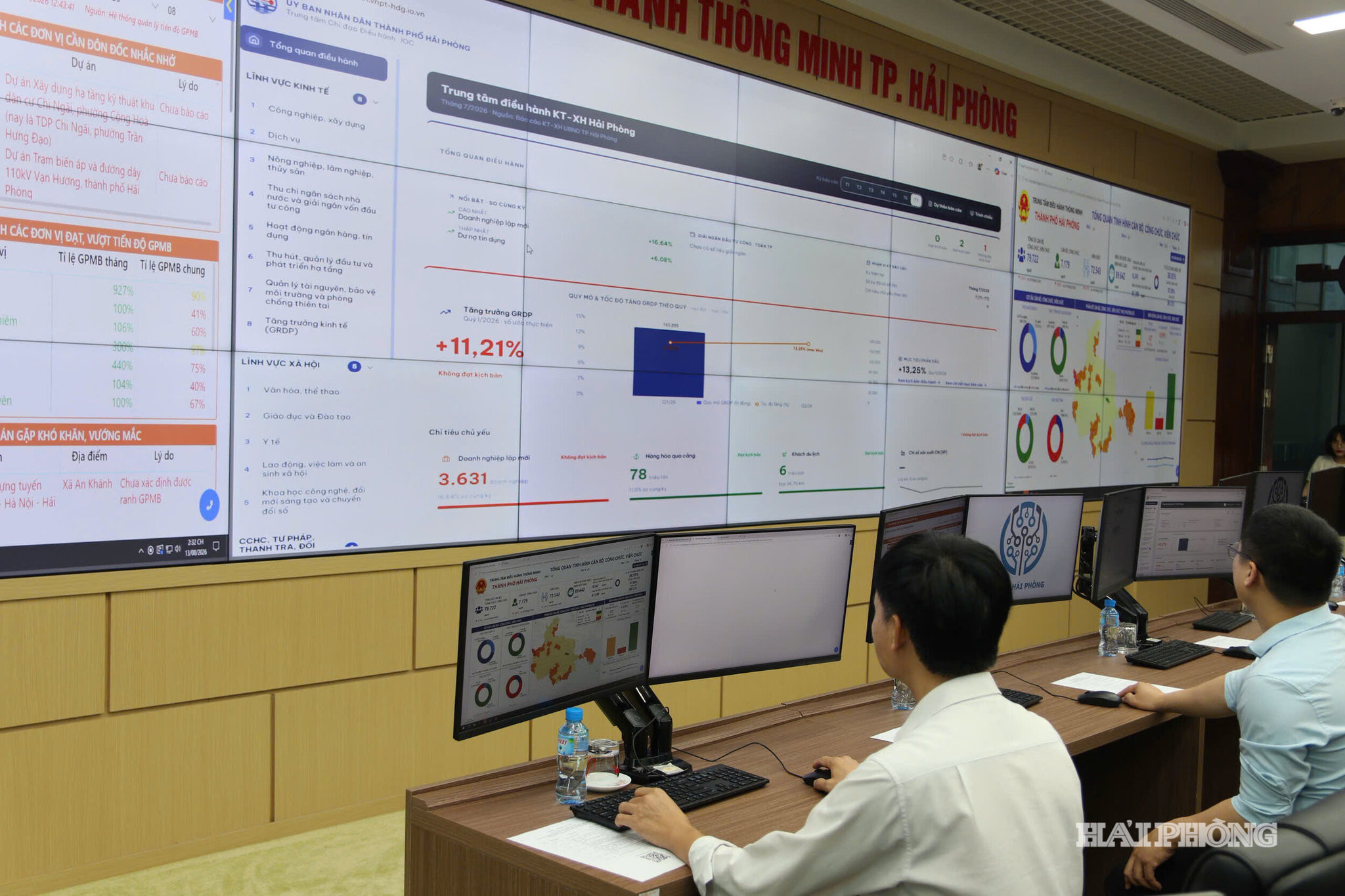
The city has also set up a task force to implement the data strategy, supporting leadership and administration; reviewing sectoral and field-specific databases; building, refining and cleaning data; and organizing the connection, integration and sharing of specialized data to the Intelligent Operations Center (IOC).
Notably, Hai Phong People’s Committee has directed departments, agencies and localities to implement Government’s Decree No. 314/2026 on data marketplace activities, gradually turning data into a resource serving digital government, the digital economy and the digital society.
When data truly becomes a governed, connected and effectively exploited resource, it will serve as a key foundation for Hai Phong to build a modern governance model and create additional momentum for sustainable development in the digital era.
Hai Phong News