
Gửi bình luận
Growing demand for safe food is driving the development of production chains built around the goal of ensuring cleanliness and safety “from farm to table.”
.jpg)
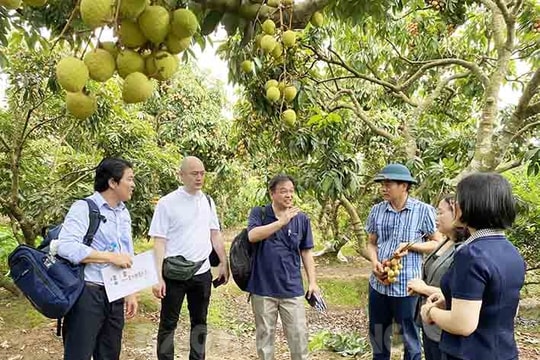
Guava has long been a familiar source of income for many households in Ha Nam Commune. Recognizing that selling raw produce offers limited added value, Ms. Luong Thi Cuc, a member of the Nam Vu Clean Agricultural Products Cooperative, and other members sought a new direction, focusing on deeper processing to increase the value of their products.
Using young guava shoots that had previously been largely untapped, the cooperative researched and developed herbal guava shoot tea. Beyond focusing on the quality of raw materials, the Nam Vu Cooperative has established a safety-oriented production process covering every stage, from cultivation and harvesting to preliminary processing, drying, and packaging. These stringent standards help preserve the product’s natural flavor while meeting increasingly demanding market requirements.
A major turning point came when the product joined the One Commune One Product (OCOP) Program. Support in completing the production process, packaging, labeling, and traceability system has helped Hà Nam guava shoot tea gradually establish its own brand. “Participating in OCOP has not only helped standardize the product but also build consumer trust. It has also created opportunities for local products to reach more markets,” Ms. Cuc said.
While the story of the Nam Vu Cooperative is one of increasing the value of agricultural products by leveraging local raw materials, Ms. Nguyen Thi Diep (Nguyen Ngan) of Le Dai Hanh Ward has taken a different path, building a clean food chain from the foundation of organic production.
Ms. Diep’s journey did not begin with agricultural trading but with research and production of IMO microbial preparations for treating organic waste. Through composting models, soil improvement initiatives, and support for farmers adopting clean farming practices, she gradually built connections with organic farmers. As she saw growing market demand for safe food, she decided to establish Moc Xanh Mart Co., Ltd. (Ba Trieu Street, Le Thanh Nghi Ward) to professionalize production and distribution.
From a small club supplying organic vegetables and fruits, Moc Xanh Mart has gradually developed into a model connecting producers with consumers, with the goal of building a product chain that is “clean from the field to the dining table.”
For Ms. Diep, selling clean food is not simply about selling products but about building trust. “We do not select products based solely on paperwork; we select them through real-life experience. Once we have chosen this path for the health of the community, there is absolutely no room for carelessness or superficiality,” Ms. Diep said.
From these small but persistent initiatives, the concept of “clean products” has gradually expanded into a “clean value chain,” where every link is geared toward ensuring consumer safety.
.jpg)
While clean-production models previously operated largely in isolation, the trend toward building interconnected supply chains is now seen as a fundamental solution for ensuring the sustainable development of clean agricultural products.
Consumers’ needs go beyond simply purchasing safe products. They also want to know where the products are grown, how they are produced, and who is responsible for their quality.
This requires the establishment of an integrated system covering production, processing, transportation, and distribution, with transparency serving as a decisive factor.
Recognizing this trend, the Hai Phong Association of Women Entrepreneurs has identified the development of clean product chains as one of its key priorities, aiming to support its members in promoting economic development alongside social responsibility. One notable initiative is the establishment of the “Farm-to-Table Clean Products” Club. The club is not simply a platform for promoting products but also serves as a space connecting businesses, cooperatives, producers, and consumers.
Through the club, members can share experience in applying food safety standards, stay updated on food safety regulations, connect with buyers and distribution channels, build their brands, and expand their markets. More importantly, the club aims to establish an integrated supply chain in which members jointly commit to ensuring product quality, maintaining transparent origins, and complying with clean production processes.
According to a representative of the Hai Phong Association of Women Entrepreneurs, the long-term goal is not merely to help members sell more products, but also to foster a culture of safe food consumption within the community.
From orchards, fields, and farms to clean-food retail outlets, every product made with integrity contributes to strengthening consumers’ trust…
THANH HOA