

Gửi bình luận
After 18 months of implementing Resolution 57, artificial intelligence has emerged as the sector with the fastest pace of institutional development and implementation, gradually laying the foundation for enhancing the nation's competitiveness.
AI gradually becomes a strategic technology
After 18 months of implementing Politburo Resolution No. 57 on breakthroughs in science and technology development, innovation, and national digital transformation, artificial intelligence (AI) has emerged as one of the sectors with the fastest pace of institutional development and implementation.
From being viewed primarily as an application technology, AI is gradually being recognized as strategic infrastructure closely linked to data, computing capacity, innovation, and national digital sovereignty.
Prime Minister's Decision No. 21/2026 promulgating the List of Strategic Technologies and the List of Strategic Technology Products places the digital technology group—including AI, big data, digital twins, cloud computing, edge computing, the Internet of Things (IoT), and blockchain—at the top of the list.
Among the 30 strategic technology products, Vietnamese large language models, virtual assistants, and sector-specific AI applications are prioritized within the group of products that already have established markets and the potential to generate significant economic impact. This reflects the country's orientation toward gradually mastering AI across multiple sectors.
One of the most significant developments during the 18 months following the implementation of Resolution 57 is that AI has, for the first time, been placed at the center of the national development strategy, becoming a strategic technology that will determine national competitiveness in the digital era. The Resolution sets the goal of positioning Vietnam among the top three countries in Southeast Asia in AI research and development by 2030, while gradually mastering strategic technologies such as AI, the Internet of Things, big data, cloud computing, semiconductors, and quantum technology.
This orientation has quickly been translated into concrete mechanisms and policies. Regulation No. 05 of the Central Steering Committee for Science and Technology Development, Innovation, and Digital Transformation identifies the development of national digital resources and the use of data and AI as key drivers of socio-economic development.
Conclusion Notice No. 45 issued by the Steering Committee's Working Group further reaffirms that AI development and application are strategic priorities for enhancing national competitiveness. This has been accompanied by the promulgation of the Law on Digital Transformation, the Law on Artificial Intelligence, the drafting of the National AI Strategy, and the proposal to establish a National Artificial Intelligence Development Fund.
For the first time, Vietnam has established a relatively comprehensive system of mechanisms, policies, and legislation dedicated specifically to AI, laying the foundation for a sustainable AI development ecosystem.
After 18 months of implementing Resolution 57, Vietnam's approach to AI has also undergone a notable shift. Whereas most enterprises previously relied primarily on foreign AI models to develop products, there is now a growing trend toward investing in core AI technologies.
According to the report reviewing the first 18 months of Resolution No. 57, AI has begun to be applied in public administration, governance, and service delivery through virtual assistants, chatbots, text analysis, forecasting, image recognition, traffic monitoring, and professional support across numerous central and local government agencies.
Many enterprises have also increased their investment in AI. FPT Corporation has partnered with NVIDIA to invest approximately USD 200 million in building an AI Factory, providing high-performance computing infrastructure and developing more than 20 generative AI products. Viettel, VNPT, VinAI, and Zalo continue to develop Vietnamese large language models.
At the local level, AI applications are becoming increasingly widespread. The Hanoi People's Committee has signed a cooperation agreement with CMC Technology Group for the 2026–2030 period to promote digital government, the digital economy, the digital society, and digital citizenship.
According to Mr. Truong Viet Dung, Vice Chairman of the Hanoi People's Committee, the partnerships with CMC, Viettel, VNPT, MobiFone, and FPT are intended to mobilize social resources for comprehensive digital and AI transformation while helping citizens, household businesses, and small and medium-sized enterprises gain access to digital platforms and new technology services.
Under the cooperation framework, Hanoi and CMC will jointly study the development of a concentrated digital technology zone integrating data centers, cloud computing, AI, research and development centers, innovation spaces, research institutes, universities, and digital workforce training systems. The two sides also plan to establish an education and research complex focusing on AI, semiconductors, and digital technologies in Thuong Cat and Hoa Lac.
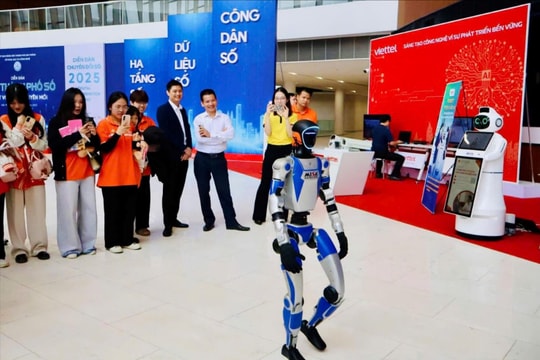
In Ninh Binh, AI reception robots, digital assistants, and AI-powered solutions supporting administrative procedures have been introduced at the Public Administrative Service Center, helping guide citizens, reduce waiting times, assist officials in handling administrative tasks, and accelerate the digitalization of administrative records.
Completing the AI ecosystem to enhance national competitiveness
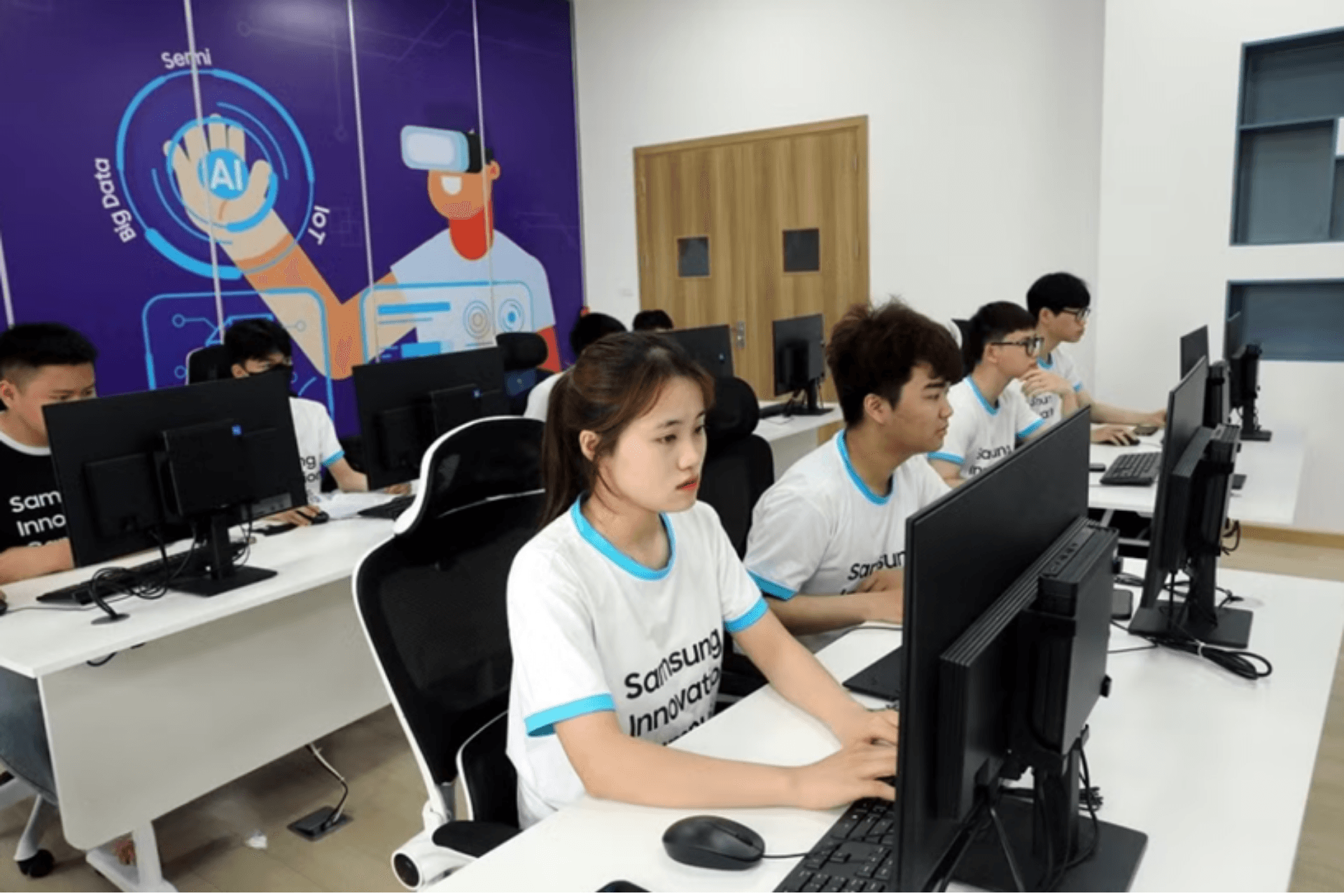
The initial achievements have helped establish core capabilities for the development of Vietnam’s national AI ecosystem, including computing infrastructure, Vietnamese-language models, and a research workforce capable of mastering AI technologies.
However, the report reviewing the first 18 months of implementing Resolution No. 57 also identifies several limitations. Although the scope of AI applications has expanded and a number of AI models have been integrated into real-world operational processes, most applications remain focused on information retrieval, data summarization, and recognition tasks. Only a limited number of processes have been completely redesigned around AI, deployed at scale, and evaluated through measurable performance outcomes. Sector-specific data remains fragmented and uneven in quality, while computing infrastructure and highly skilled AI professionals continue to be major bottlenecks.
The report proposes establishing a Vietnam Autonomous AI Alliance, led by technology enterprises, research institutes, and universities. It also recommends developing a national open data platform for AI training, completing Vietnam's AI ethics framework and technical standards, and focusing on major AI applications such as virtual assistants for administrative procedures, early disaster warning systems, automated cybersecurity defense, digital support for public administration, and smart urban governance.
After 18 months of implementing Resolution 57, Vietnam's AI ecosystem is gradually taking shape, with key foundational elements including institutions, data, computing infrastructure, technology enterprises, human resources, and an application market.
Recently, the Ministry of Science and Technology issued a National Evaluation Framework for AI Platforms Supporting Public Administration, marking another important milestone in the governance and development of AI.
The evaluation framework sets out requirements covering legal compliance, personal data protection, AI security, the ability to cite legal grounds, and the provision of assistance strictly within the platform's designated professional scope before AI platforms can be piloted or officially deployed.
Notably, the framework clearly stipulates that AI serves only as a tool for consultation, analysis, and information synthesis. All administrative decisions remain under the authority of government officials and civil servants, who bear full legal responsibility for those decisions. The framework also establishes technological sovereignty requirements for AI platforms used in the public sector. Platforms that do not employ Vietnamese large language models developed by Vietnamese enterprises or that lack AI training and inference infrastructure located within Vietnam will not be eligible to participate in pilot programs.
It is evident that, after 18 months of implementing Resolution 57, Vietnam has gradually laid the foundation for a national AI ecosystem. In the next phase, the key challenge will be transforming these foundations into genuine competitive advantages by developing AI products, platforms, and enterprises capable of supporting the country's development while progressively expanding into international markets, thereby contributing to a new growth model driven by knowledge, data, and innovation.
Hai Phong News