Gửi bình luận
Linking a more than 200-year-old dried rice noodle craft village with Co Island scenic area is opening up new opportunities for Nam Thanh Mien Commune (Hai Phong) to develop distinctive local tourism.
.jpg)
From a more than 200-year-old craft village...
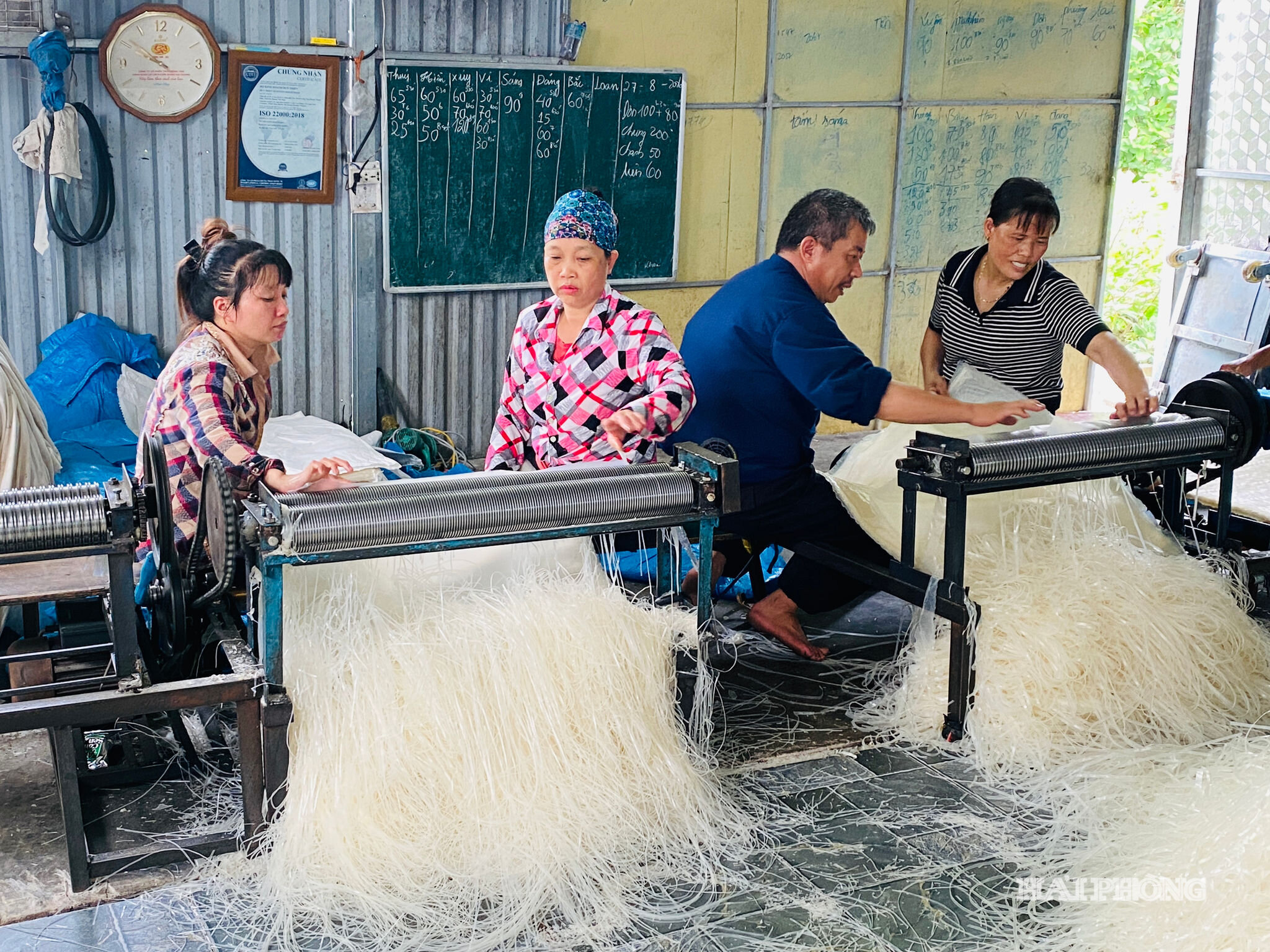
The family of Vu Duy Trien in Hoi Yen Hamlet, Nam Thanh Mien Commune, produces about 10 tons of dried rice noodles each month for distribution to neighbouring provinces and cities.
Duy Trien production and trading household is one of the larger producers in Hoi Yen Hamlet. Located in a small alley, the family operates two production and packaging areas opposite each other, employing about 10 local workers. The process includes soaking and grinding the rice, fermenting the batter, spreading and drying the rice noodles, cutting them and packaging the finished products.
Nguyen Thi Vuong, Head of Hoi Yen Hamlet, said records showed that the rice noodle-making trade was started by the family of Vu Duy To in the late 18th century. Despite many ups and downs, the craft has never died out in Hoi Yen. The area is predominantly agricultural, with favourable natural conditions, clean water and high-quality rice that is white, fragrant and sticky. Local residents have used these advantages to produce batches of dried rice noodles renowned for their flavour.
In the past, Hoi Yen dried rice sheets were mainly sold locally. The products are now sold in many provinces and cities, from Vietnam’s northwestern region to the south. They have also become a local speciality that Vietnamese people take overseas, helping to raise the profile of the traditional product.
Vu Anh Hoan, who is from Nam Thanh Mien Commune, said including a visit to the dried rice noodle craft village in tours of Co Island would make the local tourism experience more diverse. Many craft villages in other provinces and cities have attracted visitors by combining visits to historical sites with opportunities to experience local culture.
About 70 km from central Hanoi, Co Island in Nam Thanh Mien Commune lies in the An Duong and Trieu Duong lake area. Covering nearly 70 hectares, it is a distinctive scenic area rarely found in northern provinces and cities.
Co Island is home to a diverse ecosystem of more than 170 animal and plant species. It is also a habitat for many valuable bird species, including common coots, wild ducks and garganeys. Some of these species are listed in Vietnam Red Data Book and face the risk of extinction, and are being strictly protected.
Co Island draws not only visitors from Hai Phong but also tourists from many other localities. Boat tours across the lakes and around the islands allow visitors to observe birds nesting and feeding in their natural habitat. In the early morning and late afternoon, tens of thousands of birds flying to and from the islands create a distinctive landscape reminiscent of Vietnam's Mekong Delta.
In 2014, the Ministry of Culture, Sports and Tourism recognised Co Chi Lang Nam as a national scenic heritage site in An Duong Hamlet. Ten years earlier, the Hoi Yen dried rice noodle making village in Hoi Yen Hamlet was recognized as a traditional craft village. These designations provide favourable conditions for the locality to combine Co Island tourism with visits and hands-on experiences at the craft village, enabling visitors to gain a deeper understanding of local culture while increasing residents' incomes and sustaining the traditional trade.
However, these advantages have yet to be fully developed. Linking the Co Island scenic area with the long-established Hoi Yen dried rice noodle craft village would not only enrich the visitor experience but also create new opportunities to preserve the traditional craft, generate livelihoods and increase the value of local tourism.
Hai Phong News