

Strengthening supply capacity and industrial capabilities
Hai Phong aims to have 450 – 500 supporting-industry enterprises capable of joining the supply chains of FDI businesses and multinational corporations by 2035.
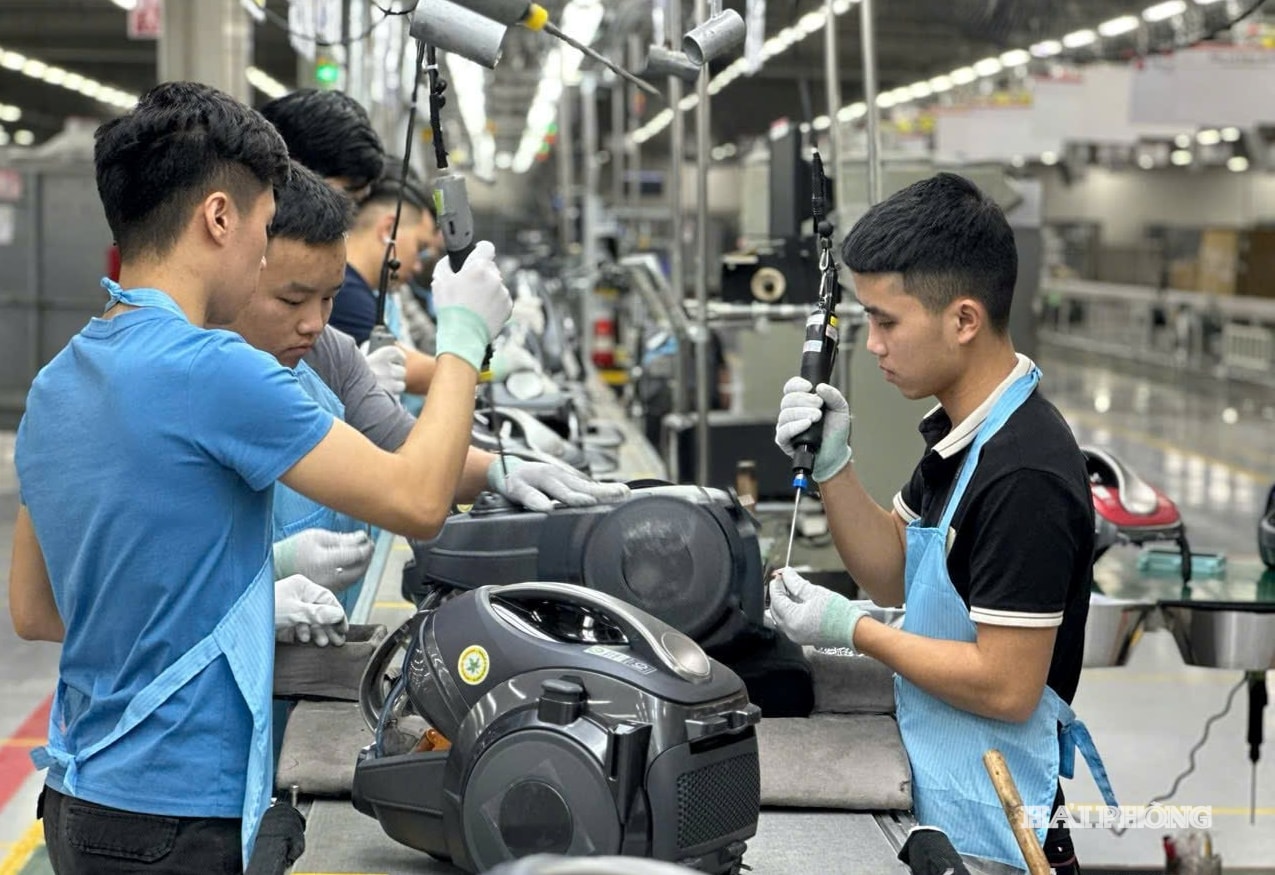
To secure orders, supporting-industry enterprises must meet their partners' requirements for quality, pricing and delivery deadlines. Therefore, connection and introduction to partners need to go hand in hand with assisting businesses with technological improvement and production arrangement that meet buyers' requirements.
These were also among the key priorities at a recent conference to launch Hai Phong's Supporting Industry Development Program for 2026 – 2035. At the event, representatives of Samsung Vietnam introduced consultancy projects on smart factories, smart molds and automation. The Hai Phong Department of Industry and Trade and Samsung Electronics Vietnam Co., Ltd. signed a memorandum of understanding on cooperation to support the development of supporting-industry enterprises. Implementing these cooperation initiatives in line with each company's improvement needs will help enhance its ability to fulfill orders.
Hai Phong's Supporting Industry Development Program for 2026 – 2035 focuses on developing supporting industries for five key sectors: electronics, high technology, mechanical engineering and manufacturing, automobiles, and textiles, garments and footwear. By 2035, the city aims to achieve localization rates of 35 – 40% in electronics, 20% in high technology, 50% in mechanical engineering and manufacturing, 32 – 40% in automobiles, and 70% in textiles, garments and footwear.
At the same time, Hai Phong aims to have 450 – 500 supporting-industry enterprises, forming a core group with the capacity to conduct research, design, manufacture and directly supply major domestic and international corporations.
To achieve this, the program identifies support for improving management capacity, workforce training, research, innovation and technology transfer. These tasks need to be implemented in a coordinated manner and tailored to the production conditions of individual businesses.
The localization targets set specific requirements for the development of domestic production. Enterprises must gradually take on more production stages and supply additional components, spare parts and materials that meet manufacturers' requirements. Each sector has its own technological characteristics, product standards and needs. Support measures therefore need to clearly identify product groups with development potential, businesses capable of participating and limitations that need to be addressed.
These requirements are becoming increasingly pressing as investment and production in the city continue to expand. In the first 10 months of 2026, Hai Phong attracted more than USD 3.8 billion in foreign investment, up 69% year on year, while export turnover reached USD 50.1 billion, equivalent to 96.3% of the annual target.
Alongside attracting investment projects, the city needs to build a pool of enterprises capable of supplying them. If domestic businesses cannot meet the required standards, opportunities to participate in production activities locally will remain difficult to turn into actual contracts.
Therefore, consultancy projects on smart factories, smart molds and automation need to help businesses address specific production limitations, such as quality control, reduction of defect rates and on-time delivery. Investment in equipment must go hand in hand with workforce training and improved management.
Businesses must also proactively allocate resources and sustain improvements after receiving consultancy support. Consistent production capacity is essential for being selected by partners and securing repeat orders.
The development of supporting industries should be assessed by actual results in supply chain participation. Alongside the number of businesses receiving consultancy and connection, it is necessary to monitor how many meet the required standards, secure contracts and maintain supply relationships. These results will demonstrate the program's effectiveness and help adjust support measures to better reflect practical needs. Only when domestic enterprises are capable of winning and fulfilling orders will the city's target to raise the localization rate have a solid foundation.
LE HIEP