
Mobilizing private investment for strategic transport axes
Hai Phong is promoting investment attraction through the public-private partnership (PPP) model and leverage land resources to develop strategic transport routes.
Expanding strategic transport links
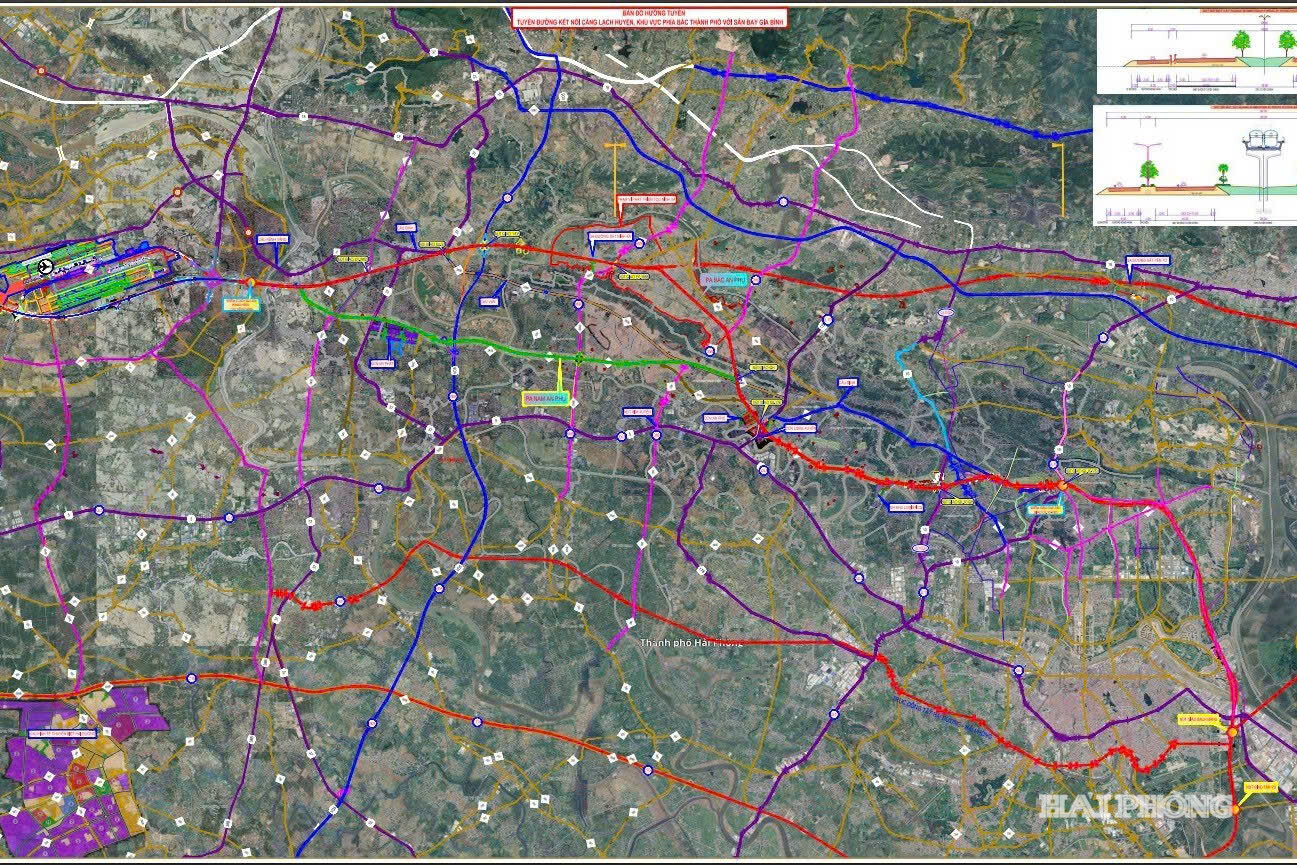
Hai Phong is seeking interested investors for the project to build a road connecting Lach Huyen Port with Gia Binh Airport.
The route will be approximately 46.55 km long, including around 44.8 km through Hai Phong City. To mobilize resources, the city is seeking investors interested in studying the project under the PPP model, with a BOT or BT contract expected to be applied. If implemented under a BT contract, the preliminary proposal is to compensate the investor with land funds along both sides of the route and other land reserves within the city, in accordance with PPP regulations.
The City Department of Finance has announced a list of 19 land plots covering approximately 4,562 hectares, with an estimated value of VND 75.91 trillion, for investors to refer to when studying potential land-based payment arrangements in the event that a BT contract is adopted.
Alongside this project, the East-West road has also been designated for implementation under the PPP model, with a BT contract involving payment in the form of land funds for the section developed under this arrangement.
The project is approximately 23.59 km long, starting at its intersection with National Highway 10 and ending at the connection with Ring Road 1 in the former Hai Duong City. Its preliminary total investment is estimated at around VND 22.669 trillion.
The project is divided into three component projects. The city will allocate budget funds for site clearance, resettlement support, and relocation and reinstatement of technical infrastructure along the entire route.
It will also finance the construction of the section from the intersection with National Highway 10 to Tinh Thuy Road. The estimated budget allocation is approximately VND 7.552 trillion.
The remaining section, from Tinh Thuy Road to the end of the route, has an estimated investment of around VND 15.117 trillion and is expected to be implemented under the PPP model through a BT contract, with payment in the form of land funds.
Under the preliminary plan, the land fund proposed as payment to the investor comprises seven plots in Hong Bang, An Hai, An Duong and Thuy Nguyen wards, covering a total area of approximately 360.28 hectares. This approach combines infrastructure investment with the mobilization of land resources, creating a basis for attracting capital from non-budget sources.
Unlocking resources and creating new growth opportunities
Under the City People's Committee’s Decision No. 3991/QD-UBND dated September 25, 2026, on the list of priority projects for investment attraction in the city for the 2026-2030 period, a number of large-scale transport projects have been identified to strengthen regional connectivity and links between seaports, airports and urban and industrial development areas.
In addition to the East-West road and the Lach Huyen-Gia Binh corridor, the list includes projects to complete Ring Roads 2 and 3, build a road connecting National Highways 5 and 10, and construct a road along An Kim Hai canal.
The PPP model creates opportunities to mobilize private-sector resources for large-scale infrastructure projects, while the State budget must also cover many other development priorities. For BT projects, payment through land funds provides an additional financing option, linking infrastructure investment with the use of land resources.
For the East-West road project, in addition to the approximately VND 15.117 trillion expected to be mobilized by the investor, the city will still need to allocate around VND 7.552 trillion from the budget to carry out tasks under the State's responsibility.
This demonstrates that PPP does not mean transferring all investment responsibilities to the private sector. The effectiveness of this model depends on the reasonable allocation of responsibilities, resources and risks between the State and investors, while ensuring the project's financial feasibility.
When integrated with seaports, airports, railways, industrial parks and urban areas, new roads will help establish economic corridors, improve freight transport capacity and enhance the attractiveness of the investment environment.
HA NGA