

When digital transformation reaches residents
Stepping up the implementation of the Politburo’s Resolution No. 57-NQ/TW, digital transformation in Hai Phong is becoming increasingly practical, bringing greater convenience to residents.

Digital transformation reaches every resident
After her son gave her a smartphone, Nguyen Thi Hang, a resident of Hoang Mai residential group in An Hai Ward, was shown by members of the local Community Digital Technology Team how to install and use a number of useful digital platforms, such as VNeID, cashless payment services and online public services. From initially feeling unfamiliar with the technology, Hang now considers her smartphone indispensable.
For the family of Le Van Thanh in Dong Khe Street, Gia Vien Ward, using smartphones for daily transactions has become routine. To register his grandchild’s birth or obtain a citizen ID card for himself, Thanh only needs to open his phone, log in to the VNeID app, verify his personal information and prepare the necessary electronic documents. No longer having to wait or make multiple trips, digital technology has helped his family save time and costs while strengthening their confidence in a modern public administration.
The experiences of Hang and Thanh’s family are both evidence and a concrete measure of the effectiveness of digital transformation efforts in Hai Phong over the past time. Digital transformation is no longer an abstract or unfamiliar concept but is closely connected to everyday life, with residents at the center and as the beneficiaries.
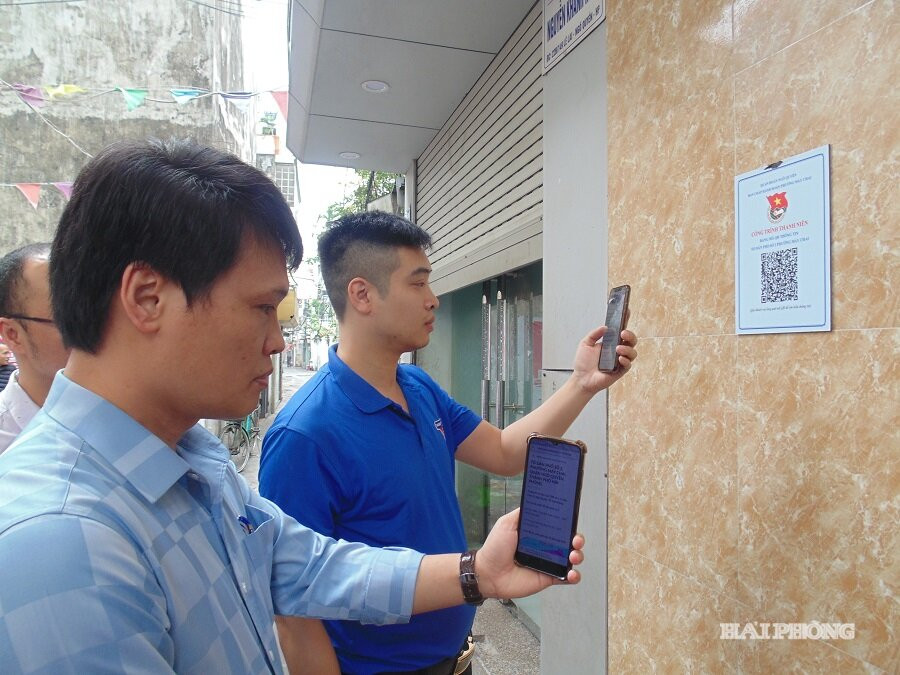
To bring about these changes, “Digital Literacy for All” programs and “Community Digital Technology Teams” have been widely established in villages, residential groups and residential areas across the city to help residents access and use essential digital services.
The city has established more than 3,790 Community Digital Technology Teams, with more than 17,000 members. These teams serve as the core force in spreading digital knowledge and skills to every household and resident, giving everyone opportunities to access and use digital services easily, safely and increasingly conveniently, and become digital citizens.
Foundation for digital government building
Digital transformation is not limited to community life but is also becoming deeply integrated into the management and operations of grassroots governments in Hai Phong. The ultimate goal is to better serve residents.
Many localities across the city are taking the lead in introducing digital applications and platforms to support governance and administration, disseminate information and gradually establish ways for local authorities and residents to connect and interact in the digital environment, with a view to building a “friendly government” that is close to the people.

Nguyen Quoc Thai, Chairman of the Ngo Quyen Ward People’s Committee, said that in early August 2026, the ward officially put the Tammi OA super app platform into operation to support digital government building. Through Tammi OA, residents can proactively send messages, images, feedback, petitions and comments directly to local authorities on emerging issues, creating a fast, direct and effective two-way interaction mechanism.
As residents gain greater access to and become more proficient in using digital applications, accelerating the development of specialized databases is the core foundation for moving toward the operation and comprehensive development of digital government. Therefore, the city is directing this task to be implemented synchronously and urgently, thereby enabling residents to conveniently and consistently access and use information in the digital environment. According to Nguyen Cao Thang, Director of the Department of Science and Technology, the city’s shared data warehouse has integrated more than 700 specialized datasets, with around 6 million records.
Hai Phong is gradually moving further along its journey toward becoming a smart city, where every decision is based on data and every service is designed to best serve residents. This is also the goal of the digital transformation drive that the city is stepping up.
NGOC LAN