

A new approach to urban flood prevention
Hai Phong is stepping up efforts to tackle urban flooding through science- and technology-based solutions, alongside urban planning strategies designed to adapt to climate change.
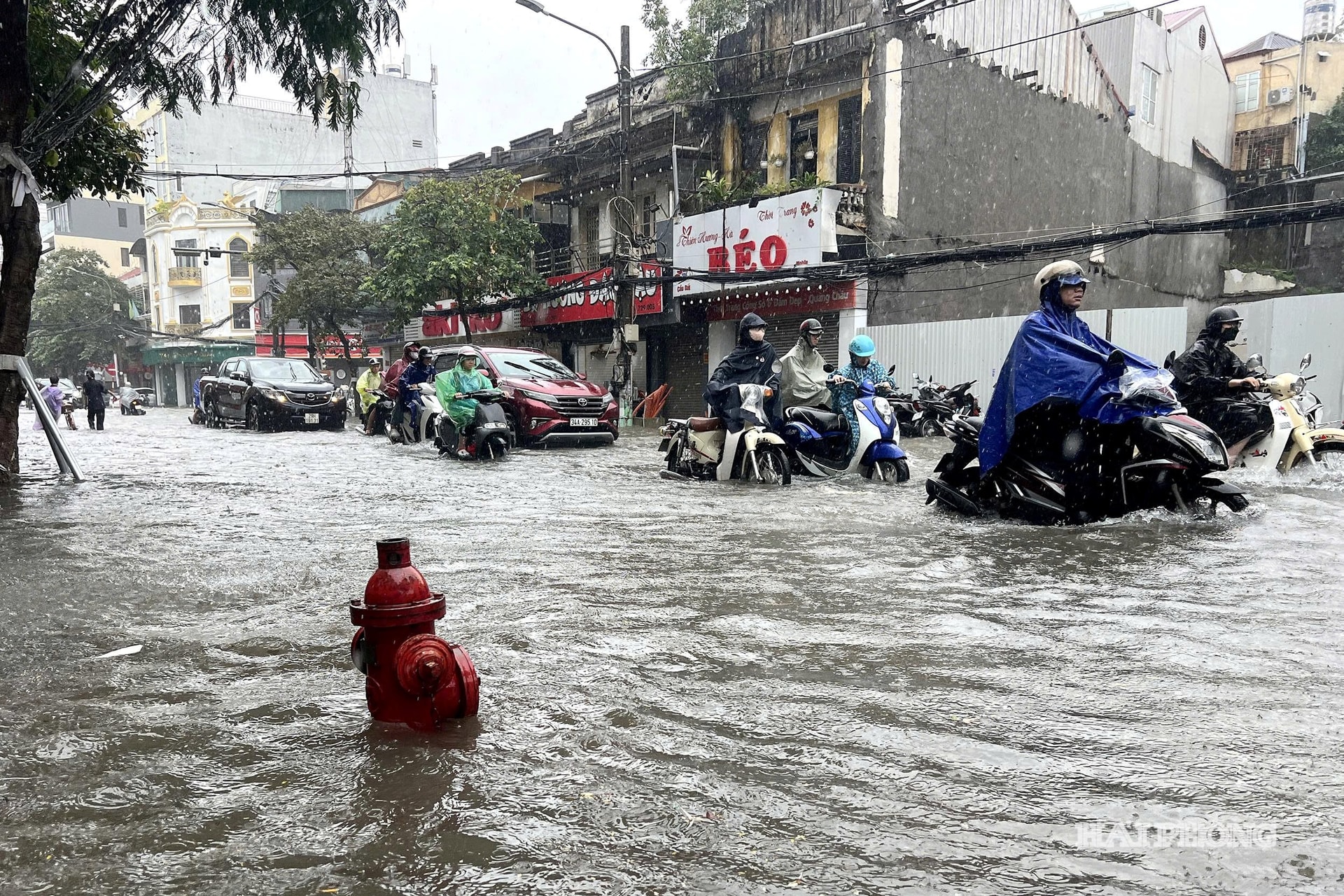
Every rainy season, urban flooding once again becomes a major concern. Whenever heavy rainfall coincides with high tides, many central streets in the city—including Cau Dat, Le Loi, Lach Tray, To Hieu, and Luong Khanh Thien—experience localized flooding, disrupting traffic, daily life, and business activities.
Localized flooding is caused not only by heavy rainfall but also by the combined effects of several factors, including low-lying terrain, rising sea levels, rapid urbanization that has reduced the land's natural water absorption capacity, and aging drainage systems in many areas that were built decades ago.
More importantly, scientific projections indicate that Hai Phong will face increasing pressure in the coming decades. According to studies by the Institute of Meteorology, Hydrology, Environment and Marine Sciences, sea levels in the Hai Phong area could rise by approximately 19.7 centimeters by the middle of the 21st century, or 24.3 centimeters when land subsidence is taken into account.
By the end of the century, under a high-emissions scenario, sea levels could rise by around 50.7 centimeters, or up to 59.4 centimeters when combined with geological subsidence.
In particular, if sea level rise, high tides, storm surges, and large waves occur simultaneously, extreme water levels could place enormous pressure on the city's sea dike system and coastal infrastructure.
Meanwhile, monitoring data show that sea levels in Hai Phong increased by an average of 4.8 millimeters per year between 1993 and 2023. Record-high tides continue to be observed, while rainfall has become increasingly concentrated over shorter periods. A single rainfall event of 100–150 millimeters, coinciding with a high tide, can overwhelm the drainage system and result in widespread flooding.
These warnings demonstrate that flood prevention can no longer be viewed simply as a matter of responding after each heavy rainfall. Instead, it must become an integral part of the city's long-term urban development strategy.
As climate change becomes increasingly severe, traditional flood-control measures—primarily focused on expanding drainage pipes, dredging canals, and installing additional pumping stations—are unlikely to meet the demands of sustainable urban development.
This is why the recent scientific workshop, "Applying Technology to Urban Planning for Flood Prevention and Climate Change Adaptation in Hai Phong," attracted significant attention from policymakers and the scientific community.
What made the workshop particularly noteworthy was not merely its identification of flood-prone areas, but its introduction of a fundamentally new approach to urban planning. Rather than addressing individual infrastructure projects separately, experts agreed that cities should be planned to become more resilient and adaptable to climate change from the outset through integrated spatial planning, infrastructure development, and urban governance.
This direction was also emphasized by leaders of the city's Department of Construction in their opening remarks, stressing that urban planning must stay one step ahead by fully integrating disaster risk management, flood mitigation, and climate change adaptation.
Encouragingly, Hai Phong has chosen not to rely on conventional approaches. Instead, the city is boldly pursuing innovative solutions built on digital transformation and the achievements of the Fourth Industrial Revolution.
For the first time, technologies such as Digital Twins, Artificial Intelligence (AI), the Internet of Things (IoT), Geographic Information Systems (GIS), and Big Data have been introduced into discussions as practical tools to support urban planning and flood management.
If implemented in an integrated manner, these platforms would enable authorities to simulate the entire urban drainage system, forecast flooding under different rainfall events and tidal cycles, and make faster and more accurate management decisions.
Alongside digital transformation, experts have also recommended that Hai Phong rethink its infrastructure development strategy by working in harmony with nature. Rather than focusing solely on expanding underground drainage networks, the city should simultaneously invest in green infrastructure solutions such as retention ponds, floodable parks, rain gardens, permeable pavements, the preservation of natural water storage areas, and the restoration of riverine and coastal ecosystems.
In addition, the Sponge City model, which has proven effective in many countries, has been identified by urban planning and geological experts as a suitable long-term approach for Hai Phong.
From a governance perspective, it is encouraging that the city is not limiting its efforts to technology research alone. Instead, it is gradually integrating flood prevention measures into revisions of the city's master plan, land elevation planning, surface drainage systems, and technical infrastructure development. This is a necessary step to ensure that all future development projects take into account climate change, sea level rise, and extreme weather scenarios.
Nevertheless, turning these ideas into reality will take time. Investing in monitoring systems, shared databases, urban digital twins, and comprehensive upgrades to the drainage infrastructure requires substantial financial resources. However, the cost of delaying action would be far greater as climate change continues to become more unpredictable while urbanization accelerates.
Hai Phong is moving rapidly toward its goal of becoming a modern industrial city and a national center for logistics and the maritime economy. Achieving this vision requires urban infrastructure that is resilient enough to adapt to the growing challenges posed by climate change.
For this reason, the city's proactive search for effective flood-control solutions reflects a forward-looking approach to urban governance. It also represents the aspirations of Hai Phong's residents, who hope to see these solutions translated into concrete projects, infrastructure, and smart management systems in the near future.
Nguyen Duong