
Hai Phong shipbuilding poised for a return to growth
A growing number of new orders is creating opportunities for the recovery and renewed growth of Hai Phong’s shipbuilding industry.
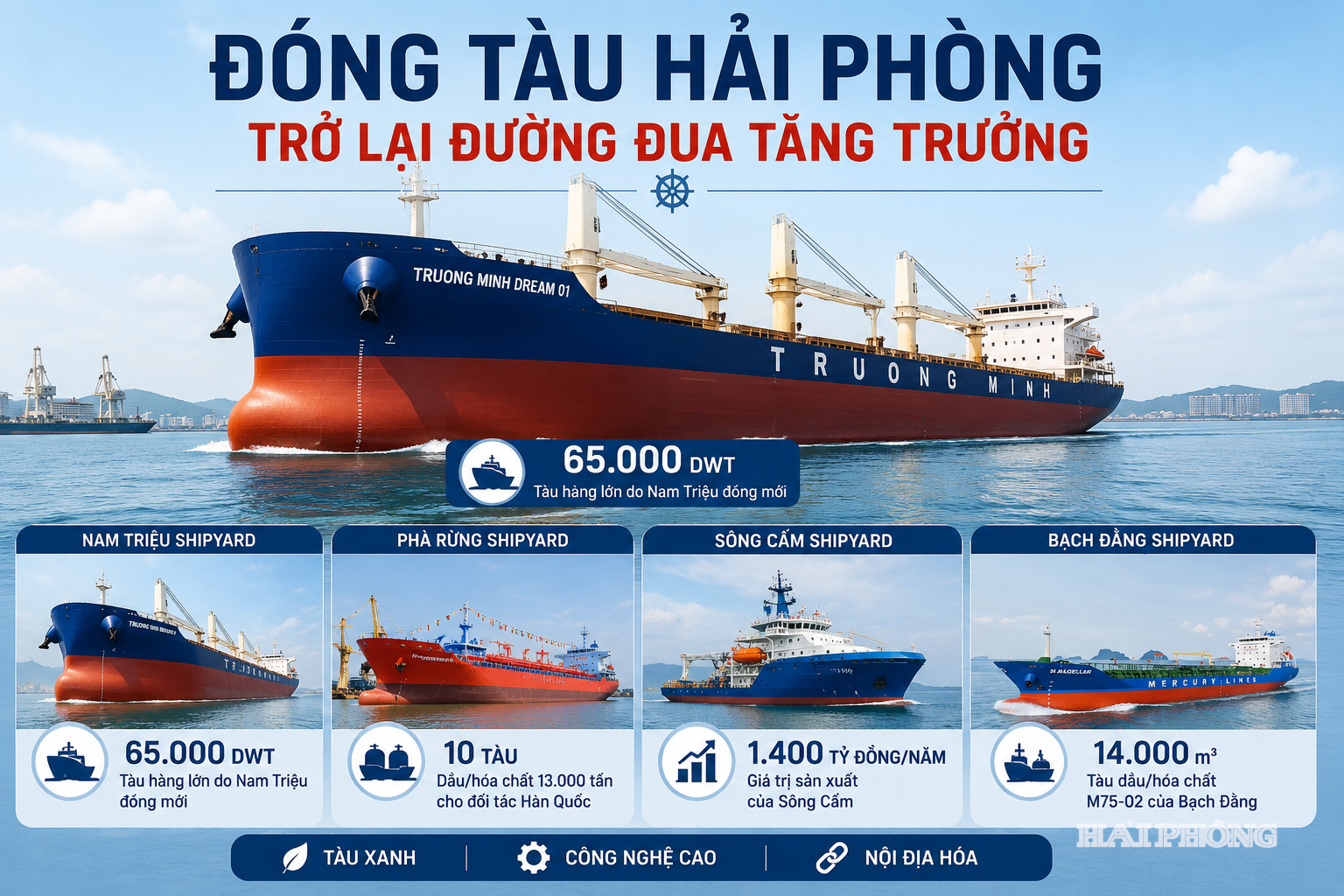
On June 13, Bach Dang Shipbuilding One Member Co., Ltd. held a keel-laying ceremony for the construction of a 14,000-cubic-meter oil/chemical tanker, designated M75-02, for Mercury Line Co., Ltd. The vessel is the second in a series of three specialized tankers being built by the company, following M75-01, which is currently in its final completion stage ahead of delivery.
The event marks not only another milestone for Bach Dang Shipbuilding but also reflects increasingly clear signs of recovery in Hai Phong’s shipbuilding industry after years of restructuring.
In recent years, Hai Phong’s shipbuilding sector has recorded a number of encouraging developments. Nam Trieu Shipbuilding One Member Co., Ltd. successfully launched a 65,000-DWT cargo vessel, one of the largest cargo ships currently designed and built entirely in Vietnam. Pha Rung Shipbuilding One Member Co., Ltd. has begun implementing a contract to build 10 oil and chemical tankers of 13,000 tons each for a South Korean customer and achieved production output worth VND 846 billion in 2025. Song Cam Shipbuilding Joint Stock Company continues to generate annual production value exceeding VND 1.4 trillion through export orders to Europe. Meanwhile, Pacific Shipbuilding Joint Stock Company has maintained its competitiveness in the segment of vessels ranging from 15,000 to more than 30,000 tons. These achievements demonstrate that an industry once considered a source of pride for the Port City is gradually returning to a growth trajectory.
Speaking at the seminar “Vietnam’s Materials and Mechanical Manufacturing Industries in a New Development Phase” on June 15, Mr. Pham Tuan Hai, Deputy Director of the Hai Phong Department of Industry and Trade, noted that the city’s shipbuilding industry over the past three decades has mirrored the broader challenges and achievements of Vietnam’s economic reform and integration process.
During the early years of the market economy, shipyards had to operate independently despite shortages of capital, technology, and markets.
Between 2000 and 2008, alongside the rapid expansion of Vinashin, Hai Phong emerged as Vietnam’s leading shipbuilding hub, attracting significant investment and fostering a large-scale shipbuilding ecosystem.
However, the global financial crisis from 2008 to 2012, combined with weaknesses in the industry's development model, plunged the sector into an unprecedented downturn. Many companies were forced to restructure, reduce production, and struggle to preserve employment while retaining skilled engineers and workers.
A turning point came in 2013 when the shipbuilding industry entered a comprehensive restructuring phase. Many enterprises shifted toward specialized, higher-value-added vessels and niche markets.
Notably, even during its most difficult period, Hai Phong managed to preserve the industry's core strengths: its shipyards, experienced engineering workforce, skilled labor force, and long-standing industrial tradition. These foundations have enabled companies to recover gradually as global shipping markets improve and the transition toward greener maritime transport creates new opportunities.
Despite positive signs, recovery alone does not guarantee sustainable development. Today, Hai Phong's shipbuilding industry faces challenges that extend beyond securing new orders. The sector must strengthen its competitiveness in technology, green transformation, and global supply chains. Key constraints include: limited land availability for shipbuilding and supporting industries; shortages of highly skilled technical personnel; continued dependence on foreign partners for the design and manufacture of core equipment; low localization rates; insufficient integration among supporting industries. As a result, Hai Phong's objective cannot simply be to restore production at individual companies. Instead, it must focus on building a modern shipbuilding ecosystem.
The city's proposed development model of an Integrated Shipbuilding Industrial Complex is viewed as a suitable path forward. The model would strengthen linkages among shipbuilders, supporting mechanical engineering firms, research institutions, universities, and logistics providers within a unified value chain. Achieving this vision will require strong policy support in areas such as: land allocation; access to credit; investment attraction; development of supporting industries; training of high-quality human resources. Most importantly, strengthening domestic ship design capabilities and mastering core technologies should be treated as strategic priorities. Doing so would increase localization rates and generate greater value-added in each vessel produced.
Hai Phong’s shipbuilding industry now has an opportunity to return to the growth race. However, turning that opportunity into sustainable development will require a long-term vision capable of positioning shipbuilding as a cornerstone of the marine economy, creating spillover benefits for mechanical engineering and supporting industries, and reinforcing Hai Phong’s status as Vietnam’s leading maritime industrial center in the years ahead.
Hai Hau