

Delegating authority for four procedures and reducing eleven administrative procedures in crop production sector
Authority for four administrative procedures has been delegated to Chairpersons of provincial-level People's Committees.
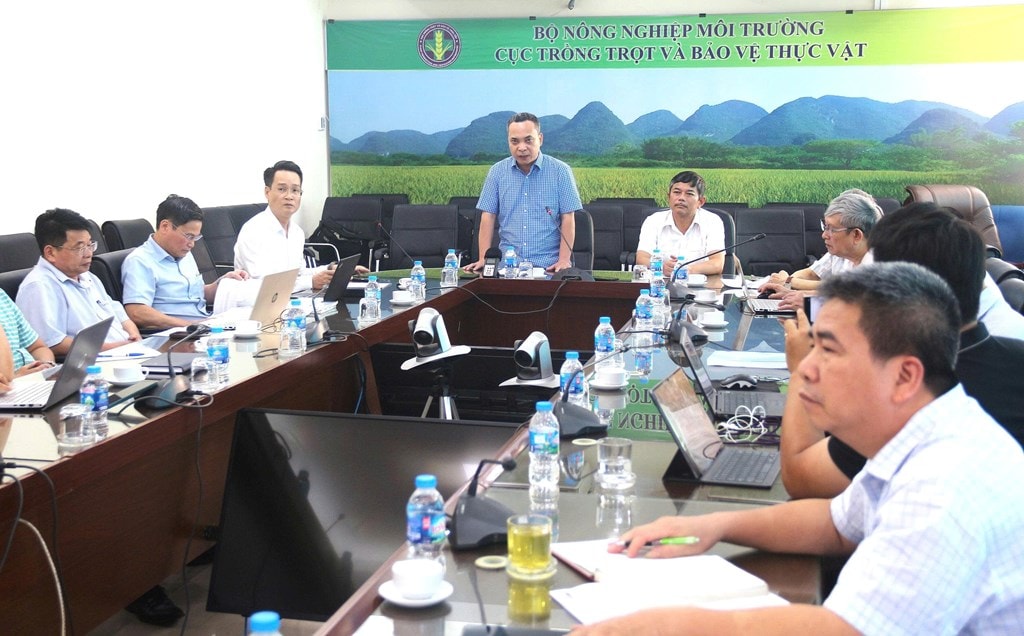
On the afternoon of June 8, the Department of Crop Production and Plant Protection under the Ministry of Agriculture and Environment held an online conference to implement Government resolutions and a ministerial circular on decentralization, delegation of authority, reduction of business investment conditions, and simplification of administrative procedures in the fields of crop production, plant protection, and plant quarantine.
Speaking at the conference, Mr. Nghiem Quang Tuan, Deputy Director General of the Department of Crop Production and Plant Protection, said the new regulations are intended to ensure consistent implementation from the central to local levels while creating maximum convenience for citizens and businesses engaged in agricultural production, trade, and import-export activities.
According to Mr. Nghiem Quang Tuan, this marks an important step in institutional reform, shifting from pre-inspection to post-inspection management, promoting decentralization alongside enhanced supervision and oversight, increasing the initiative and accountability of local authorities, reducing compliance costs, shortening administrative processing times, and improving the business and investment environment.
In the crop production and plant protection sector, the Ministry of Agriculture and Environment has delegated authority for four administrative procedures to provincial-level People’s Committee Chairpersons. These include: inspection of the quality of imported plant protection products; certification and re-certification of fragrant rice varieties eligible for preferential tariff treatment upon export; and special recognition for the circulation of plant varieties.
The ministry has also abolished 11 administrative procedures, primarily in the areas of plant variety protection, fertilizers, plant protection products, and crop variety testing. In addition, 17 administrative procedures related to fertilizer and pesticide registration, plant variety protection, and the issuance of certificates of eligibility for production and business operations have been simplified.
Notably, the ministry has removed the requirement to inspect pest conditions at production sites in exporting countries for imported plants accompanied by soil, helping businesses reduce costs and processing time. In addition, state inspection procedures for food safety of imported plant-origin products have been delegated to agencies assigned or designated by provincial-level People’s Committee Chairpersons.
Regarding business investment conditions, the Ministry of Agriculture and Environment has removed two conditional business sectors: plant protection services and crop variety testing services. It has also narrowed business conditions in the fertilizer and plant variety sectors.
At the conference, representatives from the Tay Ninh Provincial Rural Development Sub-Department noted that some pesticide manufacturers had already obtained certificates and declared active ingredient contents. However, when they need to change active ingredients, they are currently required to complete procedures for declaring a new product, resulting in additional time and costs.
Responding to this issue, Ms. Bui Thanh Huong, Head of the Plant Protection Product Management Division, said that the sector now has only two administrative procedures: issuance of new certificates and renewal certificates in extension cases. Under current regulations, any changes to information recorded on an existing certificate require a new application.
She added that the Department of Crop Production and Plant Protection will continue reviewing and proposing amendments to relevant regulations as part of efforts to further simplify administrative procedures, facilitate business operations, and reduce pressure on management agencies.
Addressing questions regarding the delegation of authority for fragrant rice certification, Mr. Nguyen Van Vuong, Head of the Crop Variety Management Division, said that from July 1, 2026, provincial authorities will officially take responsibility for certifying fragrant rice varieties eligible for import tariff exemptions under quotas when exported to the European Union under the EVFTA and to the United Kingdom and Northern Ireland under the UKVFTA.
To implement this regulation, the Ministry of Agriculture and Environment has requested provinces and cities to submit specimen signatures and official seals of authorized officials responsible for issuing fragrant rice certificates and re-certificates before June 5, 2026. The ministry will then compile and forward the information to the European Union and the United Kingdom in accordance with regulations.
However, to date, only eight of the 34 provinces and cities have submitted the required documentation. Mr. Nguyen Van Vuong urged localities to promptly assign authority and send specimen signatures and seals to the ministry.
He warned that delays could directly affect fragrant rice exports, as the delegated mechanism officially takes effect on July 1, 2026.
Responding to questions on whether field inspections are required before issuing fragrant rice certificates, Mr. Nguyen Van Vuong explained that certification is based on documentation as prescribed in Government Decree No. 103/2020 on the certification of fragrant rice varieties exported to the European Union.
The dossier already includes a field inspection report prepared and certified by an authorized testing organization. Therefore, issuing authorities are not required to conduct additional on-site inspections. The maximum processing time for the procedure is five working days, helping facilitate export activities.
The conference also reviewed key contents of Government Resolution No. 17/2026 on reducing, decentralizing, and simplifying administrative procedures and business conditions under the management of the Ministry of Agriculture and Environment; Resolution No. 66.19/2026 on decentralization and simplification measures; and Circular No. 22/2026 issued by the Minister of Agriculture and Environment.
Concluding the conference, Mr. Nghiem Quang Tuan expressed confidence that, through the clarification of local concerns and the implementation of the new policies, the reforms would soon deliver practical benefits, contribute to a more transparent business environment, promote agricultural export growth, and strengthen the competitiveness of Vietnamese agriculture in international markets.
According to VNA