
Greening industrial parks to attract high-quality investment capital
Hai Phong is gradually transforming its industrial parks through green development initiatives, aiming to promote sustainable growth and attract high-quality investment capital.
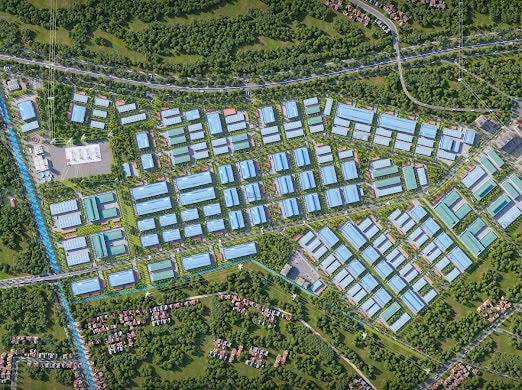
In the context of global trends toward green development, the circular economy, and increasingly stringent emissions-reduction requirements, the “greening” of industrial parks is no longer merely an encouraged option. It has become an essential requirement for enhancing competitiveness and ensuring sustainable growth.
A recent meeting between the Hai Phong Economic Zone Authority and leaders of industrial park infrastructure developers and operators highlighted the city’s strong determination to advance the development of eco-industrial parks in conjunction with green transformation and sustainable economic growth.
As of early 2026, Hai Phong had established 46 industrial parks covering a total area of approximately 13,009 hectares. Under its long-term development plan, the city aims to expand to 69 industrial parks with a combined area of nearly 18,900 hectares. While this scale reinforces Hai Phong’s position as one of Vietnam’s leading industrial centers, it also brings increasing demands in terms of environmental protection, resource efficiency, energy management, and sustainable development.
Hai Phong is currently a national pioneer, with two industrial parks—Nam Cau Kien and Dinh Vu—selected as pilot projects for transformation into eco-industrial parks. These projects serve not only as pioneering models but also as evidence that green industrial transformation is entirely achievable with the right commitment and implementation approach.
Notably, both industrial parks already meet more than 80 percent of international eco-industrial park criteria. Their planning and development include key requirements such as allocating at least 25 percent of land to green spaces, underground utility systems, centralized waste treatment facilities, wastewater recycling for irrigation, road cleaning, and industrial use, as well as attracting clean-technology industries and environmentally responsible businesses committed to sustainable development.
Both parks are now considered ready to become the first officially recognized eco-industrial parks in Hai Phong and among the first in Vietnam. This demonstrates that the city is not merely keeping pace with the green transition but is actively establishing itself as a leader in the field.
In reality, the eco-industrial park model has not diminished investment attractiveness, as some once feared. On the contrary, it is creating a new competitive advantage. As global foreign direct investment increasingly favors green, high-tech, and low-emission projects, industrial parks that satisfy ecological standards are better positioned to attract high-quality investors.
For industrial park infrastructure developers, the benefits of green transformation extend beyond corporate image and social responsibility. Eco-industrial park models can accelerate occupancy rates, reduce infrastructure operating costs, lower environmental management expenses, and improve access to green financing and support mechanisms offered by governments and international organizations. Over the longer term, they also help minimize environmental compliance risks and facilitate future investment expansion.
For secondary enterprises operating within these parks, the advantages are equally significant. Shared infrastructure, waste reutilization, energy efficiency measures, and industrial symbiosis models can reduce production costs, improve resource efficiency, and strengthen compliance with increasingly demanding international export standards.
At the recent Green Manufacturing Value Chain Cooperation Forum, themed “Development of Korea–Vietnam Green Industrial Parks and Opportunities for Hai Phong,” held in Seoul, Chairman of the Hai Phong People’s Committee Do Thanh Trung emphasized that Hai Phong is a key growth engine of northern Vietnam, home to 46 industrial parks and nearly 1,500 FDI enterprises. Faced with increasingly rigorous global production standards, the city has chosen not to respond passively but instead to take a pioneering role by using green development as a strategic lever to transition toward a low-emission economic model.
The Chairman affirmed that green industrial parks are not simply a solution to climate change challenges; they represent a decisive competitive advantage in attracting high-quality foreign direct investment.
Hai Phong is also prepared to take the lead in piloting digital platforms and carbon data management systems within industrial parks. The Hai Phong Economic Zone Authority plans to standardize ESG (Environmental, Social, and Governance) indicators and make them mandatory criteria for evaluating next-generation industrial parks. Compliance with these standards will become a prerequisite for participation in the city’s industrial ecosystem.
Clearly, the greening of industrial parks is no longer solely an environmental issue. It has become a matter of economic development, trade competitiveness, and long-term investment attractiveness.
However, achieving the full potential of eco-industrial parks will require genuine cooperation among government agencies, infrastructure investors, and the business community. Green transformation demands substantial financial resources, advanced technologies, and a long-term development mindset.
Therefore, alongside the commitment of businesses, continued efforts are needed to improve support mechanisms related to financing, credit, incentives, workforce training, and technology transfer. Equally important is the development of circular production models that promote efficient resource use, reduce emissions, and foster industrial symbiosis among enterprises within industrial parks.
Hai Phong is now presented with a significant opportunity to strengthen its position as one of Vietnam’s leading green industrial hubs. With increasingly modern infrastructure, a world-class port system, and strong investment appeal, the city possesses many of the conditions necessary to become a national leader in the development of eco-industrial parks.
Ha Vy