

From local foundations to a music city vision
Aiming to join the UNESCO Creative Cities Network in the field of music, Hai Phong needs to start from its foundational “cells” — communes and wards rich in cultural heritage.
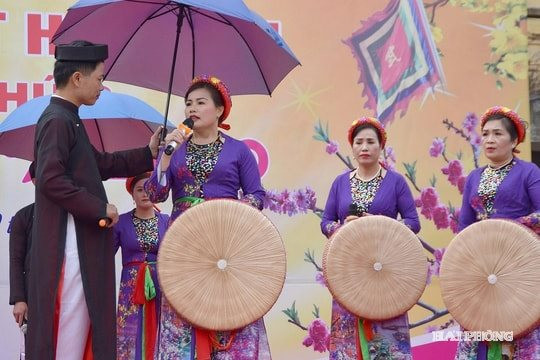
To build a sustainable “music city,” the roots must begin with traditional music. Hai Phong is fortunate to possess dense cultural heritage areas where music is woven into everyday life. Looking at the former Tong Phuc area (now Nam Trieu ward), one can see the vibrant vitality of dum singing. Here, music is not only present during spring festivals but also reaches international audiences. Artisans such as Meritorious Artist Dinh Nhu Hang are not only custodians of tradition but also “cultural ambassadors” emerging from local communities. Similarly, in Tan Ky commune, ca tru—an intangible heritage in urgent need of safeguarding—is still systematically taught in schools. When a child in Tan Ky learns to hold the phach and keep rhythm in ca tru, or when a young person in Nam Trieu can engage in hat dum exchanges, that is when the “music city” is being formed at its very core. Communes and wards serve as the safest “incubators” for preserving intangible cultural values amid the strong currents of external cultural influences. The role of grassroots administration is also evident in creating spaces for contemporary music and street art. The Bach Dang walking street and night market (Le Thanh Nghi ward) stands as a typical example. With nearly 400 clubs and more than 5,500 performances, this is no longer merely an administrative project but has become a true “people’s stage,” where the boundary between performers and audiences is blurred. At this level, local authorities act as facilitators, enabling music to permeate every corner of urban life and become part of a modern lifestyle. Without close coordination in licensing, security management, and provision of space, such community-based activities would struggle to sustain their appeal. Grassroots authorities also serve as a bridge in mobilizing social resources and encouraging artisans and young artists to contribute voluntarily. However, the transition from a “cultural movement” to a “cultural industry” at the commune level still faces many barriers. In many places, cultural activities are still viewed as occasional movements tied to commemorative events, rather than as a service sector capable of generating revenue, boosting tourism, and creating jobs. Infrastructure in many communes and wards remains limited; proper training requires dedicated spaces and standard sound and lighting equipment. Management mechanisms also tend to focus more on control than facilitation. Independent artists and young bands still face difficulties organizing spontaneous performances in public spaces due to complicated licensing procedures. For each commune and ward to truly become a solid foundation for a “Music City,” Hai Phong needs a systematic roadmap: stronger decentralization, granting greater autonomy to local authorities in organizing creative music spaces, and simplifying procedures for small-scale community performances. At the same time, it is essential to develop local human resources—nurturing artisans and training grassroots cultural officials with a mindset in cultural governance and creative economy, capable of “packaging” local music products to attract tourists. Rather than spreading investments thinly, the city should prioritize communes and wards with distinctive strengths—such as Nam Trieu with dum singing, Tan Ky with ca tru, and central wards with contemporary music—to develop model “music destinations.” Hai Phong does not lack internal resources or talent. What is needed now is substantive action from the grassroots. When each commune and ward can preserve, nurture, and spread its unique musical identity, the title of a UNESCO “City of Music” will no longer be a distant aspiration, but an inevitable outcome. Music must originate from the people, and it is at the grassroots level that this enduring flow is sustained.
Thu Huong