

Hai Phong develops human resources to affirm shipbuilding position
To regain Hai Phong’s position as the country’s leading shipbuilding center, alongside attracting and expanding orders, businesses and training institutions in the city are focusing on developing human resources.
.jpg)
Increasing demand for recruitment
Along with the recovery trend of the shipbuilding industry, the recruitment and labor market in this sector in the city is gradually warming up in 2025.
According to Ho Hai, Deputy Director of the Hai Phong Employment Service Center under the Department of Home Affairs, at recent job fairs, several companies operating in shipbuilding, marine hull fabrication, and maritime auxiliary materials, such as Dai Duong Shipbuilding Co., Ltd., Damen Song Cam Shipyard Co., Ltd., IBS Heavy Industry JSC., and AMECC Mechanical and Construction JSC., registered to recruit positions ranging from unskilled laborers and workers with basic vocational training to experienced engineers.
Some companies in this sector are offering high benefits and incentives to attract graduates in mechanics, shipbuilding, marine engine operation, welding, and related fields.
Nguyen Huy Phuong, Head of the Administration and Organization Division of Song Cam Shipbuilding JSC. in Hong An ward, said that under the company’s plan to 2030, it will build 60 ships per year.
.jpg)
The company annually needs to recruit 150 to 200 graduates in marine hull fabrication, welding, mechanical engineering, and painting. It commits to offering skilled workers a total monthly income of more than 25 million VND per person. It is cooperating with the Central Transport College No. 2 and other institutions to promptly supply and supplement human resources.
To ensure production and business operations, many units are simultaneously producing and training human resources under a “recruit first, train later” model.
Pham Van Tuan, Head of the Administration and Organization Division of AMECC Mechanical and Construction JSC., said: “We specialize in steel structures, a key material in constructing ship hulls and components, directly serving the shipbuilding industry. With more than 1,600 employees, our company always places emphasis on developing high-quality human resources.
“We are expanding cooperation with vocational training institutions nationwide to build a systematic ecosystem of training, internships, and recruitment, aiming to standardize skills to international standards and meet workforce needs for major domestic and international projects.”
Innovation in training and cooperation
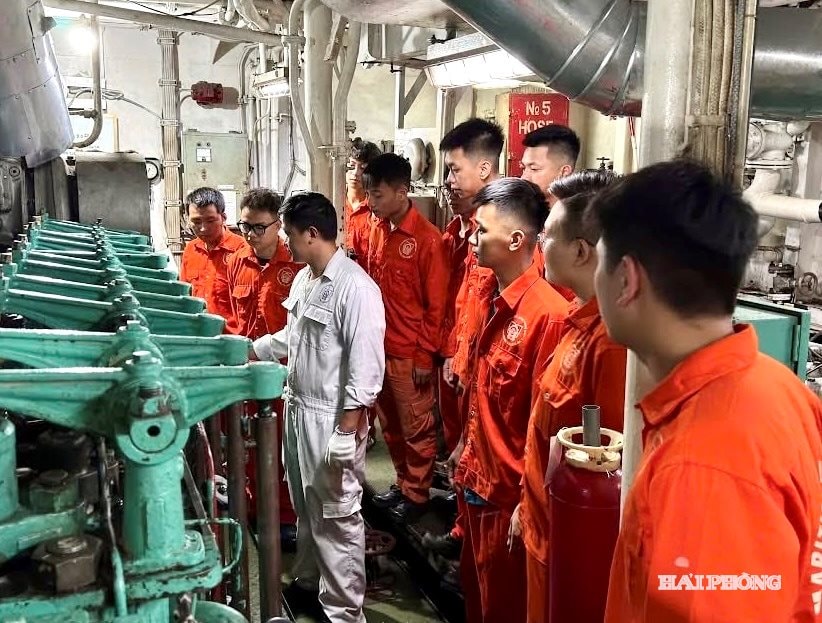
Hai Phong is home to many vocational education institutions training human resources for shipbuilding and maritime-related fields, including Vietnam Maritime University, VMU College, Maritime and Waterway College No. 1, Central Transport College No. 2, Polytechnics College, and Hai Duong Vocational College.
To ensure high-quality human resources, businesses and training institutions are strengthening cooperation to frequently update skills and new technologies in their training programs. Through such partnerships, students gain hands-on experience, equipping them with both theoretical knowledge and practical skills.
In addition, vocational education institutions have innovated teaching and training methods to meet development needs and economic trends.
Nguyen Duy Vinh, Deputy Rector of the Central Transport College No. 2, said lecturers and students from the Shipbuilding Faculty recently designed and fabricated a “4,850-ton oil tanker model” for the city’s 2025 self-made training equipment contest. The model, built at a 1:10 scale from an actual oil tanker, has a complex structure but can be dismantled into segments, supporting practical teaching for 18 out of 25 subjects and modules in marine hull fabrication technology.
In the coming period, the city is expected to implement a master plan to restore and develop the shipbuilding industry, adjusting development planning to 2040 and vision to 2050 with a focus on automation, digital transformation, environmental standards, and energy efficiency.
Therefore, developing and strengthening the workforce for the shipbuilding sector requires continued attention through fundamental and sustainable solutions.
According to Dang Van Tang, Chairman of the Hai Phong Employment and Vocational Training Association, to fill the workforce gap in shipbuilding in the coming time, universities and colleges in the city must continue to innovate and improve the effectiveness of admission to attract more students to the field.
Training institutions and businesses should enhance coordination in implementing ordering mechanisms and provide students with information about labor market needs, trends, and benefits in the shipbuilding industry, said Tang.
Preparedness in human resources is a fundamental and essential factor for Hai Phong’s shipbuilding industry to maintain its position and “take off” in the future, Tang added.
MAI LE